
Snoring Exercise App for 5-Minute Airway Training
If you snore - or sleep next to someone who does - Airway Trainer guides tongue, throat, and soft-palate exercises in a short daily routine. Here's what the science says, who it works for, and how to get started in 5 minutes a day.


What Is a Snoring Exercise App (and Who Is It For)?
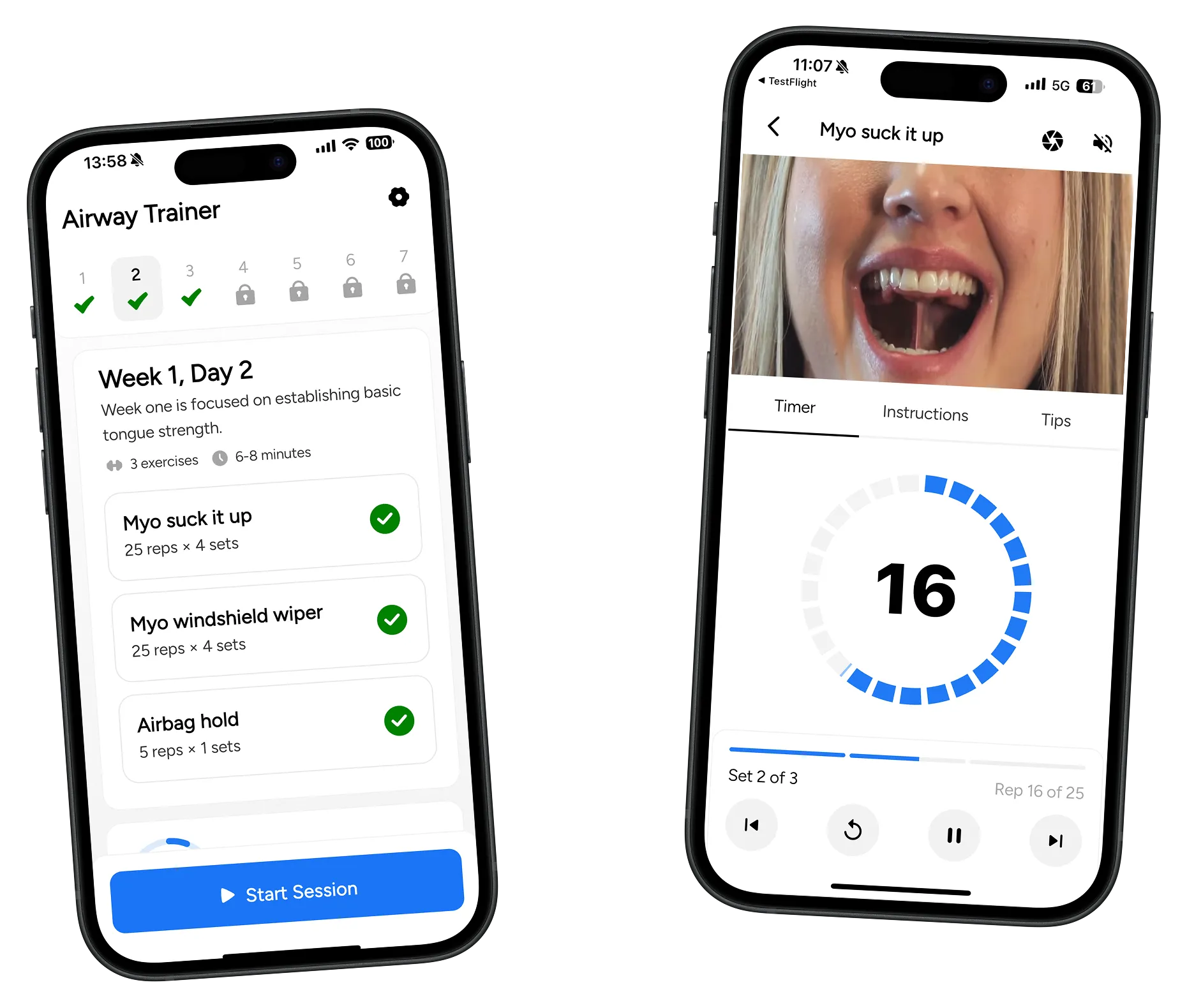
A snoring exercise app is a phone-based tool that guides you through short daily workouts for the muscles inside your mouth and throat. Think of it like a personal trainer - but for your upper airway.
When you sleep, relaxed throat muscles can narrow your airway. That narrowing creates vibrations - the sound you know as snoring. Airway exercises aim to strengthen those muscles so they stay firmer at night.
These exercises go by several names: oropharyngeal exercises, myofunctional therapy, or simply airway retraining. They all target the same goal: a quieter, better night's sleep.
Who benefits most?
- Mild to moderate snorers who haven't been diagnosed with severe sleep apnea
- Partners losing sleep - a snoring exercise app is non-invasive and avoids the awkward "wear this device" conversation (learn about snoring apps for couples)
- People who want a natural approach before trying mouthpieces or strips
- Habit builders who do well with structured, daily routines
If your snoring is mild and you're looking for something you can do on your own - no gadgets, no prescriptions - a snoring exercise app is worth a serious look.
How Snoring Exercises Work: Simple Science, No Jargon
Here's the basic idea. Your throat has muscles - just like your arms or legs. When those muscles are weak or floppy, they collapse inward during sleep and partly block your airway. Air pushing through a narrow gap makes the tissues vibrate. That's snoring.

Tongue exercises to stop snoring and soft palate exercises work by toning those muscles. A stronger tongue sits higher in the mouth. A firmer soft palate vibrates less. A tighter throat stays more open.
It's the same principle as any exercise: use the muscle regularly and it gets stronger. The difference is that you only need about 5 minutes a day.
The muscles involved
- Tongue - the largest muscle in the airway; exercises improve tongue strength and resting position
- Soft palate - the tissue at the back of the roof of your mouth; targeted soft palate exercises reduce vibration
- Pharyngeal walls - the sides of your throat; firming these helps keep the passage open
Can Airway and Tongue Training Actually Help Snoring?
Yes - and the evidence is growing. Multiple peer-reviewed studies have looked at oropharyngeal exercises for snoring, and the results are encouraging.
Key research findings
- As of April 2026, we did not identify a completed 2026 peer-reviewed randomized trial specifically on Airway Trainer.
- Historical (pre-2026) research on oropharyngeal exercises suggests potential snoring improvement in some adults.
- App-delivered myofunctional therapy is an active research area, and outcomes vary by consistency, baseline severity, and overall sleep-health factors.
Across multiple studies, airway exercises for snoring consistently show measurable improvements - especially for mild to moderate cases. This isn't a fringe idea. It's supported by published clinical research.
A pre-2026 study protocol in JMIR Research Protocols highlighted growing interest in app-delivered myofunctional therapy. As of April 2026, we have not independently confirmed published outcome data from that protocol.
What to Look For in a Good Snoring Exercise App
Not all apps are created equal. Here's a quick checklist for choosing the right one:
01 Video-guided exercises
You should be able to see exactly how to do each movement. Written descriptions alone aren't enough - proper form matters.
02 Structured progression
A good myofunctional therapy app increases difficulty over time, just like any training plan. Look for week-by-week programs.
03 Short daily sessions
Habit adherence is everything. If an app asks for 30 minutes a day, you won't stick with it. A daily 5-minute routine is the sweet spot.
04 Science-backed approach
The exercises should be based on published research - specifically oropharyngeal therapy studies. Ask: does the app cite evidence?
05 Personalized assessment
Everyone's airway is different. A personalized starting point helps you focus on the right muscles from day one.
Airway Trainer Method: 5-Minute Daily Routine + 6-Week Progression
The Airway Trainer app is a snoring exercise app designed around the principles of myofunctional therapy at home. It delivers a structured, video-guided program that takes just 5 minutes a day.
How the 6-week program works
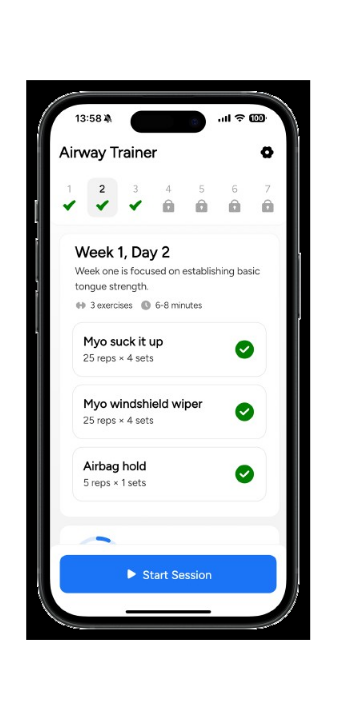
1 Weeks 1-2: Foundation
You start with a personalized assessment. The app learns about your snoring patterns and builds a plan. Your first exercises are basic tongue presses, soft palate lifts, and simple throat contractions. Each session is video-guided so you can follow along.
2 Weeks 3-4: Progression
Difficulty increases. New exercises target lateral tongue movements and deeper throat muscles. The app tracks your consistency and adjusts your plan. You're building real tongue strength at this stage.
3 Weeks 5-6: Consolidation
Advanced exercises work the full upper airway. By now the routine is second nature. You can track changes and see your progress. The goal: a habit you keep long-term.

You don't need to figure out which exercises to do or how long to do them. Airway Trainer handles the planning. You just open the app, follow the video, and close it in 5 minutes. Learn more about the science behind Airway Trainer.
Try Airway Trainer Free
Start your personalized 5-minute routine today. No mouthpiece. No strips. Just exercises that work.
Download Airway Trainer
Snoring Exercise App vs Mouthpieces, Strips, and Other Options
There's no shortage of snoring "solutions" on the market. Here's how they stack up:
| Feature | Snoring Exercise App | Mouthpiece (MAD) | Nasal Strips | CPAP | Surgery |
|---|---|---|---|---|---|
| Targets root cause | ✔ Yes - strengthens muscles | Partially - repositions jaw | ✘ No - cosmetic airflow aid | ✔ Yes - keeps airway open | ✔ Yes - restructures tissue |
| Comfort | ✔ High - nothing worn at night | Low - jaw discomfort common | High | Low - mask/hose | N/A (recovery period) |
| Daily time | ~5 minutes (daytime) | Worn all night | Applied nightly | Worn all night | One-time procedure |
| Cost | Low (app subscription) | $50-$200+ (custom: $500+) | $10-$30/month ongoing | $500-$3,000+ | $2,000-$10,000+ |
| Evidence base | Growing (multiple RCTs) | Strong | Weak for snoring | Very strong (gold standard for OSA) | Moderate (case-dependent) |
| Best for | Mild-moderate snoring | Mild-moderate OSA | Nasal congestion snoring | Moderate-severe OSA | Structural issues |
| Prescription needed | ✔ No | Sometimes | ✔ No | Yes | Yes |
A snoring exercise app is the only option that addresses the underlying muscle weakness without requiring you to wear anything at night. For mild snoring, it's a strong first step. For more severe cases, it can complement medical treatment.
Best Use Cases: Couples, Mild Snoring, Habit Builders, and More
Couples dealing with partner sleep disruption
Snoring doesn't just affect the snorer. Partner sleep disruption is one of the top reasons people seek help. A snoring app for couples gives both partners a shared, proactive solution - no finger-pointing, no awkward devices.
Mild to moderate snorers
If your snoring hasn't been linked to severe sleep apnea, exercises are an ideal starting point. They're low-risk, evidence-backed, and you can start today.
Habit builders and routine lovers
Airway Trainer's daily 5-minute routine fits neatly into a morning or evening schedule. The 6-week progression keeps you motivated - and habit adherence is built into the design.
Complementary therapy users
Some clinicians recommend myofunctional therapy alongside other treatments. If you're using CPAP or a mouthpiece, exercises can support sleep quality improvements as a complementary practice.
People who want to try before committing to devices
Unlike mouthpieces or CPAP, you can try tongue exercises to stop snoring with zero hardware. It's the simplest entry point.
Limitations, Safety, and When to Talk to a Clinician
Honesty matters. Airway exercises aren't a miracle cure, and they're not right for everyone.
When exercises may not be enough
- Moderate-to-severe obstructive sleep apnea (OSA) - CPAP remains the gold standard. If you've been diagnosed with moderate or severe OSA, talk to your doctor before relying on exercises alone. Where a clinician is comfortable adding exercise work alongside treatment, our sleep apnea exercises guide covers the drills studied in that setting.
- Structural issues - A deviated septum, enlarged tonsils, or other anatomical problems may need medical or surgical intervention.
- Central sleep apnea - This is a neurological condition, not a muscle issue. Exercises won't help here.
Safety
Oropharyngeal exercises are generally considered safe. There are no known serious side effects reported in the published literature. Some people experience mild jaw or tongue fatigue when starting - this typically resolves within days.
When to see a clinician
- You experience choking or gasping during sleep
- Excessive daytime sleepiness that affects your daily life
- A partner observes long pauses in your breathing at night
- You've tried exercises consistently for 8+ weeks with no improvement
- A wearable flagged it - see what an Apple Watch possible sleep apnea notification actually measures
Causes exercises don't address
Airway training builds muscle tone. It does not change the other things that make snoring worse on a given night. Two of the biggest are alcohol before bed and sleeping position, both of which are worth sorting out alongside a daily routine rather than instead of one.
This page is for informational purposes only and is not medical advice. Always consult a qualified healthcare professional about your specific situation. Learn more about the team behind Airway Trainer.
Real-World Outcomes, Testimonials, and 2026 Evidence
What the research shows
Let's put the numbers together from published studies:
Sources include Airway Trainer pages accessed in April 2026 and historical context studies. See Sources below.
What Airway Trainer users say
Airway Trainer reports over 200,000 users. The company claims a 56% reduction in snoring, 39% reduction in sleep apnea severity, and a 65% increase in deep sleep time. Note: These are company-reported figures and have not been independently verified in a peer-reviewed study.

"My husband noticed the difference within two weeks. I do the exercises every morning while I make coffee."
- Stacy, 44

"I tried strips and a mouthguard. Neither stuck. This is just 5 minutes on my phone - easy to keep going."
- Nathan, 64

"The videos make it so simple. I actually look forward to my daily routine now."
- Debby, 59
2026 evidence landscape
The evidence base for app-based myofunctional therapy at home is still developing. As of April 16, 2026, we have not independently verified a completed 2026 peer-reviewed outcomes paper specific to Airway Trainer. Airway Trainer terms and site pages show the product is actively maintained.
For a deeper look at the research, visit the Airway Trainer science page or read our summary on how mouth exercises reduce snoring.
Ready to Try It Yourself?
Join 200,000+ people who've started their airway training journey. Free to try - 5 minutes a day.
Try Airway Trainer Free
Frequently Asked Questions About Snoring Exercise Apps
Evidence is promising but still evolving. Historical studies on oropharyngeal exercises suggest potential benefit for some adults with snoring, and app-guided routines can improve consistency. As of April 2026, app-specific peer-reviewed outcome data remains limited.
Most studies show measurable improvements within 8 to 12 weeks of daily practice. Airway Trainer uses a structured 6-week progression, and many users report noticing changes within the first few weeks. Results vary, and consistency is key.
Absolutely. Airway Trainer is designed with couples in mind. One partner does the exercises while both can observe improvements over time. It's a practical, non-invasive option that avoids the discomfort of mouthpieces or nasal strips.
No. A snoring exercise app is best for mild to moderate snoring. If you have moderate-to-severe obstructive sleep apnea, CPAP or other medical treatments prescribed by your clinician should remain primary. Exercises may be complementary - always consult your doctor.
Airway Trainer includes exercises targeting the tongue, soft palate, and throat muscles. These are known as oropharyngeal or myofunctional exercises. Examples include tongue presses, palate stretches, and lateral tongue movements. Each session is about 5 minutes and fully video-guided.
Airway Trainer offers a free trial so you can explore the exercises and routine before committing. Download it from the App Store or Google Play to get started.
Final Takeaway: Is a Snoring Exercise App Worth Trying?
If you have mild habitual snoring and can commit to a daily routine, a snoring exercise app may be worth trying.
Current evidence suggests structured airway exercises may help some users, and app guidance can improve adherence to a consistent routine.
This approach does not replace medical treatment for diagnosed obstructive sleep apnea. For everyday snoring concerns, it is a low-risk behavioral option to discuss with your clinician.
You can also explore tongue exercises for sleep apnea if you're looking for more targeted information.
Start Your 5-Minute Routine Today
Download Airway Trainer for free. Follow the video-guided exercises. See if it works for you.
Download Airway Trainer Free
Sources (Accessed 2026)
- Airway Trainer. "Science." Accessed April 16, 2026. airwaytrainer.com/science
- Airway Trainer. "About." Accessed April 16, 2026. airwaytrainer.com/about
- Airway Trainer. "FAQ." Accessed April 16, 2026. airwaytrainer.com/faq
- Historical context (pre-2026): Ieto V, et al. "Effects of Oropharyngeal Exercises on Snoring." CHEST, 2015. journal.chestnet.org
- Historical context (pre-2026): Nemati S, et al. "Effects of oropharyngeal exercises on obstructive sleep apnea." Scientific Reports, 2024. nature.com