Mouth exercises for snoring
Mouth exercises for snoring train the soft palate, tongue posture, lip seal, and the cheek and jaw muscles that help keep the front of the airway steadier at night. Free guided 5-minute routine, no devices.




.webp)
Can strengthening the soft palate stop snoring?
Often, yes, but not usually by itself. The soft palate is a common source of snoring because it can flutter when airflow hits relaxed tissue. Acoustic and endoscopy studies consistently point to the palate as a major vibration site, which is why so many people describe their snoring as sounding like it is coming from the back of the mouth.
The other piece is that snoring is often multisite, not palate-only. One nasendoscopy study found soft palate vibration in every patient examined, but many also had lateral wall and tongue-base vibration. So a weak palate can absolutely matter, while still being only one part of the pattern.
That is also why published exercise protocols do not isolate the palate alone. Reviews of oropharyngeal exercises describe routines that train the tongue, soft palate, and lateral pharyngeal wall together. Airway Trainer follows that same logic: palate lifts matter, but they work better when tongue posture, lip seal, and cheek/jaw support improve at the same time. For the throat-side framing instead, see throat exercises for snoring or the clinical oropharyngeal exercises page. For the full pillar walkthrough, our snoring exercise app guide sequences all of these together.
*Airway Trainer is a wellness app. It does not diagnose or treat disease. Consult a healthcare provider for diagnosed sleep apnea or persistent symptoms.
Why the soft palate matters, but is rarely the whole story
Soft palate vibration gives snoring much of its recognizable sound. When the palate sags, air hits a loose flap instead of a steady surface. That is why palate lifts, controlled vowel sounds, and suction-based drills show up so often in snoring routines.
But soft-palate snoring is often mixed with other mechanics. In studies looking at where snoring starts, many people had palate vibration plus lateral wall vibration, epiglottic vibration, or tongue-base involvement. If you strengthen only the palate and ignore the rest, you may improve the sound without fully stabilizing the airway.
So this page focuses on mouth exercises, not one soft palate trick. The question is not whether the palate matters. It does. The question is whether the rest of your oral posture is helping or getting in the way.

What a good soft palate routine also trains
Tongue posture. The broad of the tongue should rest against the palate, not on the floor of the mouth where it can slide backward during sleep.
Palate engagement. The soft palate is the curtain at the back of the roof of your mouth. Drills that ask you to lift it actively are the closest thing to a "palate workout."
Lip seal, cheeks, and jaw support. Lips closed and better cheek/jaw control make mouth breathing less likely and help the front of the airway keep its shape. Airway Trainer sequences these drills over a 6-week plan instead of asking one small muscle group to do all the work.
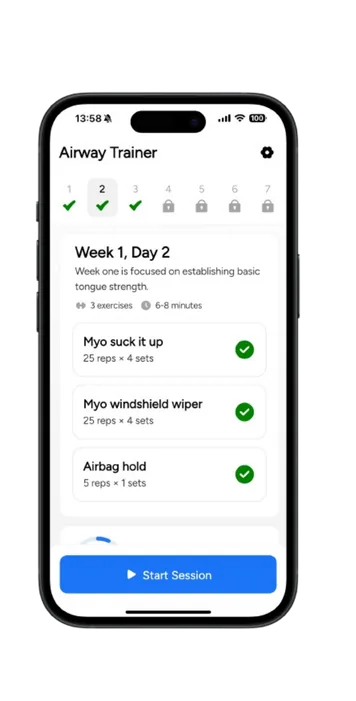
Track the difference week by week
Track your streaks, completed sessions, and weekly trends inside the app. Most users notice quieter nights within the first few weeks, and their partners notice even sooner.
No surgery, no uncomfortable mouthguards, no nightly gadgets. Just daily mouth exercises that compound into real, lasting results.
When tongue exercises stall: check the frenulum
One blocker the standard listicles miss: a short or tight lingual frenulum (the band of tissue under the tongue) can prevent the tongue from protruding straight forward - which is the single most useful direction for these drills. Instead of pushing forward, the tongue rolls down toward the chin.
London ENT surgeon Vik Veer notes that experienced myofunctional therapists routinely refer patients with restrictive tongue tie to an oral surgeon or ENT for a frenectomy so the drills can actually do their job. If you have been drilling for a few weeks and the tongue keeps rolling down on protrusion, that is the right time to ask a clinician - before you write off the program.
Everything you need in one app
Related articles
Mouth exercises for snoring FAQs
Can strengthening the soft palate stop snoring?
What are soft palate exercises for snoring?
Are soft palate exercises enough on their own?
What mouth exercises help with snoring?
Why does mouth breathing make soft palate snoring worse?
How long do mouth exercises take to reduce snoring?
When should I talk to a doctor instead of doing mouth exercises on my own?
What is the SingHealth tongue pop drill, and is it different from the tongue press?
My tongue rolls down instead of going forward when I try to protrude it. What does that mean?
Start mouth exercises for snoring tonight and notice quieter sleep in weeks. Free guided program, 5 minutes a day.