Snoring exercises
"Snoring exercises" is the umbrella term for the tongue, mouth, throat, and oropharyngeal drills studied for noisy sleep. This page is the research-backed overview: what counts, what trials measured, and how to start a guided routine.




.webp)
What "snoring exercises" actually means
"Snoring exercises" is an umbrella label, not a single routine. The category covers mouth exercises, throat exercises, tongue work, and the clinical term oropharyngeal exercises (sometimes called myofunctional therapy when delivered by a specialist). Different blog posts and product pages use different names for the same family of drills, which is part of why the topic feels confusing.
What unites them is mechanism: they all train the muscle groups that lose tone during sleep and let the airway narrow. The published research that put this category on the map measured oropharyngeal protocols specifically. In a 2015 trial in Chest, adults with primary snoring who performed daily oropharyngeal exercises for three months saw a 36% reduction in snoring frequency and a 59% reduction in total snoring power versus controls (Ieto et al.). A randomized trial in moderate OSA reported significant AHI improvements after similar exercises (Guimaraes et al., Am J Respir Crit Care Med 2009). An app-delivered version reported comparable adherence and outcomes (Goswami et al., Sleep Breath 2019).
Use this page as your starting point. If you want a routine focused on a specific muscle group or framing, the linked pages below get more specific (mouth-focused, throat-focused, clinical/ oropharyngeal, sleep-apnea adjacent). Either way, Airway Trainer packages the underlying drills into a progressive 6-week plan you can actually follow - see the snoring exercise app pillar guide for the long-form walkthrough, or screen yourself first with the STOP-BANG sleep apnea calculator.
*Airway Trainer is a wellness app. It does not diagnose or treat disease. Consult a healthcare provider for diagnosed sleep apnea or persistent symptoms.
The exact exercises researchers use in trials
Tongue slides along the hard palate. Suction holds against the roof of the mouth. Cheek resistance. Pharyngeal engagement through controlled vowel sounds. These are the drills that show up in published snoring and OSA studies.
Each exercise in Airway Trainer includes a video demo, written instructions, and rep timers so your form stays correct from the first session.

A structured plan, not a random list
After a 60-second assessment, the app builds a 6-week plan targeting your specific weak points. Tongue strength, palate control, throat toning, then advanced combinations. Each week progresses the difficulty so your muscles actually adapt.
That structure is the difference between exercises that help and exercises you abandon after a week.
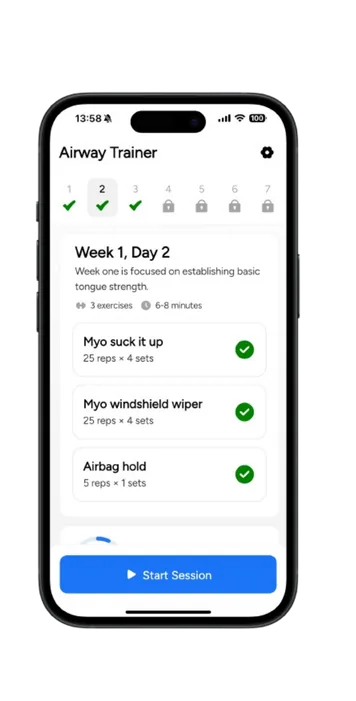
Track your progress week over week
See your streaks, completed sessions, and weekly trends. Most users notice changes within the first few weeks. By week six, the muscles that help keep your airway open are noticeably stronger.
No surgery, no mouth guards, no adhesive strips. Just daily practice that compounds.
What actually moves the needle (ENT walkthrough)
"Snoring exercises that work" is a popular search term partly because so many lists include drills that don't work on their own. London ENT surgeon Vik Veer published an endoscopic walkthrough - flexible scope in his own nose, watching his airway - that produces a useful priority list.
High-leverage drills (visibly opened his airway): tongue protrusion + depression (push forward, flatten down), palate lift (mirror-guided "pumping iron with the palate"), and high-pitch vowel work with the neck and throat genuinely engaged. Lower-leverage or actively unhelpful: pulling the tongue backward (closes the airway), low-pitch sustained growls (collapse the lateral throat walls), and anything that mimics a heavy-metal scream - that vibration is the worst-case snore.
Airway Trainer's daily session puts the high-leverage drills first so the most useful work happens whether you finish the routine or not.
Everything you need in one app
Related articles
Snoring exercises FAQs
What are snoring exercises?
Which snoring exercises have the best evidence?
How often should you do snoring exercises?
How long does it take for snoring exercises to work?
Are snoring exercises safe?
Can snoring exercises help if I also mouth breathe at night?
Which snoring drills should I prioritize if I can only do five minutes a day?
Start guided snoring exercises today and build a quieter bedtime routine in just 5 minutes a day.