Exercises to stop snoring
Snoring exercises train the tongue, palate, and throat muscles that strips, tape, sprays, and guards only work around for a night. Free guided 5-minute routine, nothing to wear in bed.




.webp)
What snoring exercises do that strips, sprays, and guards cannot
Snoring exercises train the muscles that actually make the noise - the tongue, soft palate, and throat walls that relax and vibrate as you sleep. Unlike a strip, spray, or guard you wear for a single night, the goal is to change the airway itself so it stays quieter on its own. Published non-CPAP reviews describe this oropharyngeal training as a root-cause approach rather than a nightly workaround - the difference between treating the cause and managing a symptom.
It also explains why people often feel like nasal strips "stop working." Usually the strip has not changed. It is still opening the nostrils. The mismatch is anatomical: if the main source of the noise is palatal flutter, tongue-base crowding, or multisite vibration, a nose-only fix will feel incomplete. A later systematic review of nasal dilators found no significant change in apnea-hypopnea index or snoring index in OSA patients, which is another reminder that nasal-only tools are not full-airway solutions.
Oropharyngeal exercises target a different layer. Published non-CPAP reviews describe them as training the tongue, soft palate, and lateral pharyngeal wall. In the 2015 randomized snoring trial, the control group used nasal dilator strips plus breathing exercises while the therapy group did daily oropharyngeal drills for 3 months. Airway Trainer is built around that difference: less "tonight only," more steady change through a 6-week plan that trains the tissues actually linked to vibration and collapse - for the long-form playbook, see our snoring exercise app guide or score where you stand with the free snoring score tool.
*Airway Trainer is a wellness app. It does not diagnose or treat disease. Consult a healthcare provider for diagnosed sleep apnea or persistent symptoms.
The basic routine: 5 exercises to stop snoring
Here is a starter routine for the exercises you came to find. These five oropharyngeal moves mirror the protocols used in published trials - do the whole set once a day, ideally before bed.
- 1. Tongue stretch. Stick your tongue straight out as far as it will go, toward your chin or nose, and hold about five seconds. 3-10 reps. Tones the tongue and its base.
- 2. Tongue-to-palate suction. Press the whole top of your tongue flat to the roof of your mouth, suck it up, and hold about five seconds. 3-10 reps; open your mouth while holding to make it harder. Tongue elevation and soft palate.
- 3. Lateral tongue press. Push your tongue into one cheek against a finger pressing back, hold, then switch sides. 2-5 reps each side. Tongue and cheek control.
- 4. Tongue drop (“ahh”). Open wide and lower the back of your tongue - watch the uvula rise in a mirror - or hold a steady “ahh” with the throat engaged, about five seconds. 3-10 reps. Soft palate and throat walls.
- 5. Tongue-to-teeth swallow. Hold the tongue tip behind your top front teeth and swallow while keeping it there. A few reps. Swallowing coordination and airway muscles.
In randomized trials this kind of training reduced snoring (Ieto 2015) and improved moderate sleep apnea (Guimaraes 2009); a meta-analysis found myofunctional therapy cut sleep-apnea severity by roughly half in adults (Camacho 2015). Most programs run 6-12 weeks; consistency matters more than intensity, which is the part the app handles for you.

Why nasal strips help some people and disappoint others
External nasal dilators can reduce snoring intensity in some mild snorers, especially when congestion or chronic rhinitis is clearly part of the picture. They work at the nostrils, not in the palate or tongue base. If your main problem is deeper in the airway, they may make breathing feel easier without making the bed partner much happier.
That is the real distinction from exercises. Strips and sprays are trying to improve one narrow part of the airway. Exercises aim at the muscles that actually collapse or vibrate during sleep: the tongue base, the soft palate, and the lateral pharyngeal walls. Airway Trainer isolates each muscle group with video-guided drills, rep timers, and progressive difficulty so the work translates into measurable change instead of guesswork.
Why muscle training answers a different question than strips or sprays
Most anti-snoring remedies are about getting through tonight. Muscle training is about changing the airway over time. That makes the timeline slower, but the goal is different. You are not asking, "What can I wear tonight?" You are asking, "What can I train so the airway behaves more quietly on its own?"
Random exercises from a blog will not create lasting change. Muscle adaptation requires progression: foundational moves first, then increased sets, holds, and combinations as the tissues strengthen. After a quick assessment, Airway Trainer sequences your weeks so you build tongue strength before palate control, and palate control before advanced throat toning.
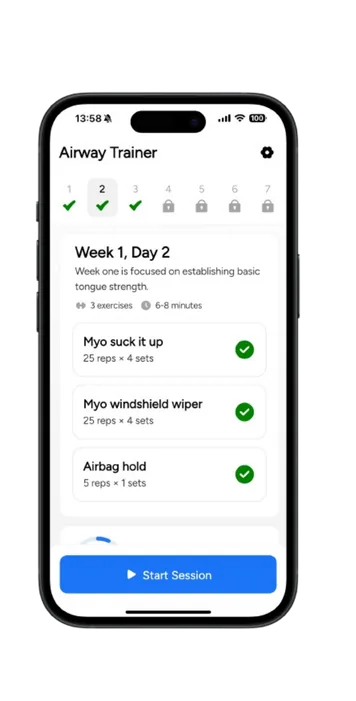
See proof it is working
Track streaks, completed sessions, and weekly trends inside the app. Most users report quieter nights within the first two to three weeks. By the end of the program your airway muscles are measurably stronger.
No surgery, no nightly gadgets, no ongoing costs. Just five minutes of daily practice that compounds into meaningful change.
Who responds - and who needs a different plan
Honest results data: published trials suggest about half of snorers see a meaningful reduction with consistent oropharyngeal work, a smaller group sees full resolution, and some see no benefit because the driver is anatomy rather than muscle tone.
The strongest responders are not who most marketing suggests. London ENT surgeon Vik Veer points out that adults losing age-related muscle mass - typically around 3% per decade after a threshold - gain the most from these drills, because that group has the most tone to rebuild. Fit younger snorers can still benefit, but they often need habit changes (nasal breathing, side sleeping, alcohol timing) alongside the drills more than they need a longer routine.
Patterns less likely to respond to exercises alone: heavy alcohol or sedatives at night, large tonsils, severe nasal blockage, marked weight gain, or moderate-to-severe untreated sleep apnea. Those need a parallel medical path. The exercises can still help - they are just not the primary lever.
Everything you need in one app
Related articles
Exercises to stop snoring FAQs
How do I stop snoring naturally?
Can exercises really stop snoring?
Why do nasal strips stop working for snoring?
Do nasal strips help snoring?
What exercises help stop snoring most often?
How long do exercises to stop snoring take to work?
Do I need equipment to do exercises to stop snoring?
Are exercises to stop snoring better than strips or sprays?
When should I see a doctor instead of relying on exercises alone?
Do exercises really work "permanently" or do I need to keep doing them?
Ready to try exercises to stop snoring? Start the free 6-week program today.