Best for understanding tracker apps
SnoreLab app review
Useful for readers who want to see what a passive snore recorder looks like before deciding whether tracking is enough.
The best snoring app is not always the one with the prettiest graph. Trackers help you understand the noise. Exercise apps help you train the airway muscles that may be causing it.


Record snoring, score nights, surface trends, and help you test remedies.
Guide tongue, throat, jaw, and soft-palate exercises over weeks.
Short version: use a tracker to learn what is happening at night. Use Airway Trainer when you want a daytime routine that targets the muscle side of snoring.
Most search results blend two different product categories. Separating them makes the buying decision much clearer.
Best for recording
Use it to hear your snoring, compare nights, and test lifestyle or product changes.
Best for guided training
Use it when you want a short daily routine for tongue, palate, and throat muscles.
Best combined setup
Measure with a tracker, then train consistently with a dedicated exercise plan.
A phone recording app is still the simplest way to hear your snoring. But newer wearables can add sleep metrics, snore recording, or breathing-related risk signals. They are useful sources of context, not interchangeable diagnoses.
Samsung’s Galaxy Ring support flow documents snore detection and optional audio recording. Its newer Galaxy Watch sleep-apnea feature is a risk signal with compatibility and market limits. Apple Watch uses a different breathing-disturbance signal. Start with the device you already own, then compare several nights before spending money on another one.
For the actual setup, read our seven-night snoring tracking guide and Galaxy Ring sleep-apnea guide.
The most useful snoring app is the one that matches your real goal. If your goal is proof, pick a tracker. If your goal is a repeatable plan that trains the tongue, throat, jaw, and soft palate muscles linked to snoring, Airway Trainer is the stronger first download.
These videos make the category split easier to understand. A tracker shows the problem. An exercise app gives you something to practice.
Best for understanding tracker apps
Useful for readers who want to see what a passive snore recorder looks like before deciding whether tracking is enough.
Best for seeing exercise-app UX
Shows the mouth-and-throat workout category Airway Trainer competes in, with guided exercises instead of overnight recording.
Best for the clinical exercise concept
A broader myofunctional exercise explainer that helps connect the app category to tongue, palate, and throat training.
Airway Trainer is intentionally shown first because this guide is about choosing an app that helps you act. Trackers are valuable, but the daily routine is where the behavior change happens.
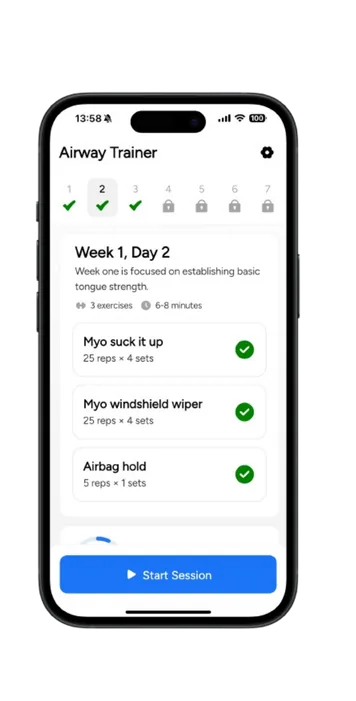


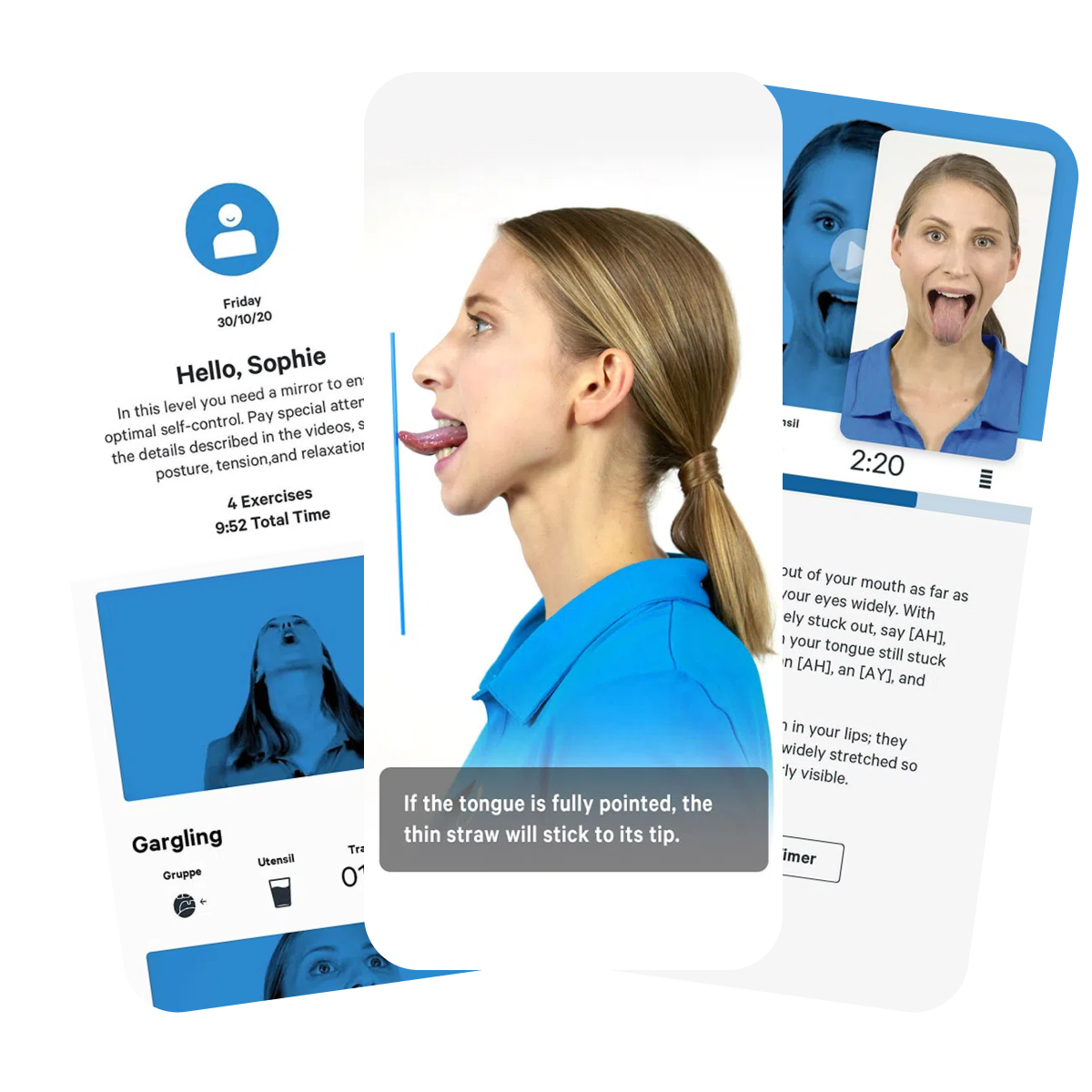
Competitor images are sourced from official app listings or official product pages. Airway Trainer mockups are first-party product assets.
Snore trackers are useful because they make an invisible problem visible. You can hear the sound, see the timing, and notice whether alcohol, congestion, sleep position, or a remedy changed the night.
But a recording is feedback, not training. If snoring is partly coming from low tone or poor coordination in the tongue, soft palate, or throat, the missing piece is daily practice. That is where a snoring exercise app earns its place.
If you are weighing specific exercise apps, see how they stack up head to head: SnoreGym vs Airway Trainer and SnoreLab vs Airway Trainer. You can also compare Airway Gym, SnoreFree, Soundly, and Oxygen Advantage with Airway Trainer.
Found that myofunctional therapy probably reduces daytime sleepiness and may improve sleep quality in the short term, while evidence certainty ranges from moderate to very low depending on outcome.
A mobile app teaching orofacial exercises reduced AHI and symptoms in a small severe OSAHS pilot trial, with the authors calling the approach promising.
In selected non-compliant OSAHS patients, an app-based myofunctional therapy program was associated with improved AHI, Epworth scores, and oxygen minimum after 90 sessions.
SnoreLab clearly positions itself as a recording and tracking app, with Snore Score, recordings, trends, and remedy tracking.
SnoreGym describes itself as an exercise app for upper-airway muscles, recommending regular practice for 8+ weeks.
Snoring can be simple airway vibration, but it can also be a sign of obstructive sleep apnea. If you have gasping, choking, witnessed breathing pauses, morning headaches, high blood pressure, or strong daytime sleepiness, use a snoring app as a clue, not a diagnosis. Exercise apps should not replace CPAP or clinician-directed care for diagnosed moderate or severe sleep apnea. If exercises cause jaw pain, tongue irritation, or unusual discomfort, stop and ask a qualified clinician.
The best snoring app depends on the job. Use a tracker if you want recordings and nightly trends. Use an exercise app if you want a routine that trains tongue, soft-palate, and throat muscles linked to airway vibration.
A recording app does not stop snoring by itself. It helps you measure patterns and test changes. An exercise app may reduce snoring for some people by improving upper-airway muscle tone, but results vary and it is not a substitute for medical care.
They solve different problems. Trackers answer what happened last night. Exercise apps answer what should I practice today. Many people use both: a tracker for feedback and an exercise app for the daily work.
Most research-backed programs look at several weeks of consistent practice, commonly 6 to 12 weeks. Airway muscle training works more like physical therapy than a one-night trick.
Talk with a clinician if you gasp or choke during sleep, have witnessed breathing pauses, morning headaches, high blood pressure, or daytime sleepiness. These can be warning signs of obstructive sleep apnea.
Start Airway Trainer and follow a guided daily plan for the tongue, throat, and soft palate muscles involved in noisy sleep.