Oropharyngeal exercises for snoring
Oropharyngeal exercises for snoring are the specific drills tested in randomized controlled trials. Airway Trainer delivers them in a guided 5-minute daily routine with no clinic visit required.




.webp)
The clinical term behind a proven approach
Oropharyngeal exercises refers to a set of targeted movements for the oropharynx, the region of the throat that includes the tongue, soft palate, pharyngeal walls, and facial muscles. These are the structures that lose tone and vibrate during sleep, producing snoring. Oropharyngeal exercises for snoring rebuild that tone through specific, repeatable drills.
The evidence is strong. In a 2015 randomized trial published in Chest, Ieto et al. showed that adults performing daily oropharyngeal exercises experienced a 36% reduction in snoring frequency and a 59% reduction in total snoring power versus controls. Guimaraes et al. (Am J Respir Crit Care Med, 2009) demonstrated significant AHI reduction in moderate OSA using similar protocols. These are the same exercises speech pathologists and myofunctional therapists prescribe in clinical settings.
Goswami et al. (Sleep and Breathing, 2019) further showed that app-delivered oropharyngeal exercise programs achieve comparable adherence and outcomes to in-person therapy. That is precisely the approach Airway Trainer takes: clinical-grade drills, delivered on your phone, with structure that keeps you consistent. For the full pillar, read our snoring exercise app guide - and pair it with the soft palate exercise breakdown for the most-cited drills.
*Airway Trainer is a wellness app. It does not diagnose or treat disease. Consult a healthcare provider for diagnosed sleep apnea or persistent symptoms.
What are oropharyngeal exercises, exactly?
The term covers exercises targeting four muscle groups: the tongue, the soft palate, the pharyngeal walls, and the facial muscles. Each group plays a role in keeping the airway open during sleep.
Airway Trainer breaks these clinical categories into simple, guided drills such as tongue slides, palate lifts, cheek resistance, and pharyngeal engagement so you train every relevant structure without needing a medical background.

The same drills researchers test, guided on your phone
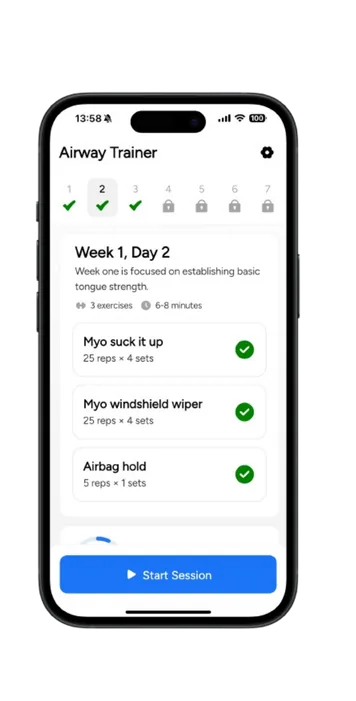
Every exercise in the app mirrors the protocols used in published trials. Video demonstrations show proper form. Rep timers ensure you hit the right volume. Written cues help you feel the target muscle engage, the same feedback a therapist would give in person.
No guesswork, no YouTube rabbit holes. Just the drills that have clinical evidence behind them, presented in a format designed for daily consistency.
Six weeks of structured progression
The program starts with a 60-second assessment to identify your weak points, then builds a 6-week plan with weekly progression. Early weeks focus on isolated muscle groups. Later weeks introduce combination drills and increased hold times to drive continued adaptation.
Track streaks, completed sessions, and weekly trends. Measurable progress keeps you motivated and gives you data to share with your doctor if you choose.
What ENT clinics use to localize collapse: DISE and VOTE
The clinical version of "where is your snoring actually coming from" is a procedure called drug-induced sleep endoscopy (DISE). A small dose of sedation, a flexible scope, and the surgeon watches in real time which part of the airway flaps, falls back, or rubs together. The four common collapse sites form the VOTE framework: Velum (soft palate), Oropharynx (lateral throat walls), Tongue base, and Epiglottis.
That matters for an oropharyngeal exercise routine because the right drills depend on which sites are active. London ENT surgeon Vik Veer makes the case that - once you know the pattern - you should train muscles that open the airway and be cautious about drills that mimic the collapse pattern. Tongue protrusion + depression opens the airway on endoscopy. Tongue pulled backward narrows it. High-pitched vowels with neck and throat engaged dilate. Low-pitched growls collapse the lateral walls (the O).
Airway Trainer's drills are sequenced from the airway-opening side of that list - useful even if you have not had a DISE, more useful if you have.
Everything you need in one app
Related articles
Oropharyngeal exercises for snoring FAQs
What are oropharyngeal exercises for snoring?
Are oropharyngeal exercises the same as mouth exercises for snoring?
Do oropharyngeal exercises for snoring have research behind them?
How often should you do oropharyngeal exercises for snoring?
How long does it take for oropharyngeal exercises to reduce snoring?
Who should talk to a doctor before relying on oropharyngeal exercises?
What is VOTE classification and why does it matter for oropharyngeal exercises?
Is there a "Tabata Mayo" minimum routine I can start with?
Get the clinical approach to snoring without a clinic visit. Start oropharyngeal exercises today, free, guided, 5 minutes a day.