Myofunctional exercises for sleep apnea
Myofunctional exercises for sleep apnea are best understood as part of the non-CPAP conversation: tongue, palate, and upper-airway training that may support treatment, especially when a clinician is weighing mild OSA options.




.webp)
Where exercises fit among CPAP alternatives for mild sleep apnea
Start with the safety point first: the American Academy of Sleep Medicine says that only a medical provider can diagnose obstructive sleep apnea or primary snoring. Home sleep apnea testing is for selected adults with symptoms and increased risk, not for general self-screening. This page should be read as treatment education, not as a shortcut around testing.
When mild OSA is confirmed, the CPAP alternative with the clearest guideline support is oral appliance therapy. AASM recommends that sleep physicians consider oral appliances for adults with OSA who are intolerant of CPAP or prefer an alternate therapy. CPAP still remains the first-line option and is more effective at improving AHI and oxygen saturation, but oral appliances are part of the legitimate mild-OSA conversation.
Myofunctional exercises fit differently. Reviews of non-CPAP therapies describe oropharyngeal exercises as training the tongue, soft palate, and lateral pharyngeal wall, with collective trials suggesting they can help reduce OSA severity and snoring. Airway Trainer works best as a supportive tool, and sometimes as part of a clinician-guided mild-OSA plan, not as a reason to skip testing or abandon prescribed therapy. The full app methodology is documented in our snoring exercise app pillar guide and the mouth-exercise research breakdown.
*Airway Trainer is a wellness app. It does not diagnose or treat disease. Consult a healthcare provider for diagnosed sleep apnea or persistent symptoms.
The CPAP alternative with the clearest guideline support
For mild obstructive sleep apnea, clinicians often discuss a custom, titratable oral appliance when CPAP is poorly tolerated or when a patient prefers an alternate therapy. AASM guidance also recommends follow-up testing and ongoing oversight from both a sleep physician and a qualified dentist.
This matters because "CPAP alternatives" is a broad internet phrase, but not every option carries the same evidence or follow-up requirements. Oral appliances are not casual gadgets. They are clinician-guided therapy.

Where myofunctional exercises belong in that conversation
The genioglossus is one of the key muscles that helps resist tongue-base obstruction during sleep, but it is not working alone. Published reviews describe these exercise programs as combining tongue work, palate lifts, and pharyngeal drills rather than focusing on a single muscle.
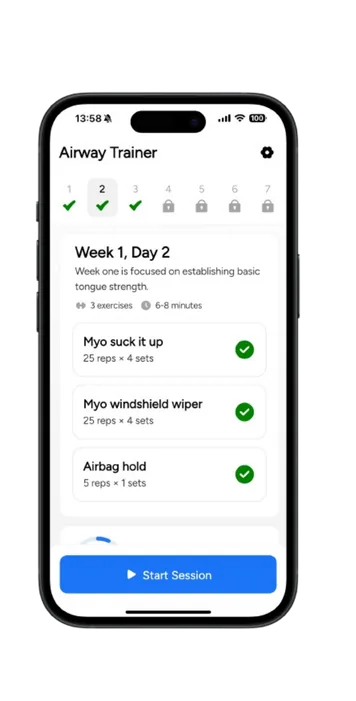
Airway Trainer uses a 6-week progression instead of a static checklist. The first week builds awareness and form. Later weeks layer longer holds, better tongue control, and combination drills so the upper airway keeps adapting. It is best used as an adjunct, and in selected mild cases as part of a clinician-guided non-CPAP plan.
Use screening to start the conversation, not end it
Snoring, gasping, choking, witnessed pauses in breathing, and daytime sleepiness are all reasons to think beyond "just snoring." AASM specifically recommends validated screening questionnaires such as STOP-BANG for people at elevated risk.
If you are not sure where you stand, use the STOP-BANG calculator as a screening step and take the result to a clinician. If you are already using CPAP or an oral appliance, share your progress with your sleep specialist so the plan stays coordinated.
The high-leverage drill an ENT surgeon points to
Not every tongue exercise pulls equal weight. London ENT surgeon Vik Veer used a flexible scope on himself to watch his airway during common snoring drills. The drill that visibly opened the most space behind his tongue was tongue protrusion + depression - pushing the tongue forward and flattening it down. That is the same motion that the Inspire and Genio implants achieve electrically. The drill that did the opposite - pulling the tongue backward - narrowed his airway.
The Sengkang General Hospital sleep unit packages a related drill with a clear timed protocol: the "tongue pop." Tongue tip behind the upper front teeth, full tongue suctioned up to the hard palate, hold a second, then flick down sharply. 10 reps × 5 sets with 5 seconds between sets. The drill trains tongue tone and the palatal tongue rest position - exactly where you want the tongue parked at night.
Airway Trainer sequences these two - protrusion-and-depression for the airway open, tongue pop for tone and rest position - early in the daily session so the most useful work happens first.
Everything you need in one app
Related articles
Myofunctional exercises for sleep apnea FAQs
What are CPAP alternatives for mild sleep apnea?
What are myofunctional exercises for sleep apnea?
Is CPAP still the first-line treatment?
Can myofunctional exercises replace CPAP?
Can myofunctional exercises be used with CPAP or an oral appliance?
How often should you do myofunctional exercises for sleep apnea?
When should I get tested instead of guessing?
How long does it take to see whether myofunctional exercises help sleep apnea?
Is one tongue exercise more important than the others?
Start myofunctional exercises for sleep apnea as a complement to your treatment with a free guided program, 5 minutes a day.