Soft palate exercises for snoring: 15 drills, routed by snoring type
Soft palate exercises for snoring target the fluttery tissue at the back of your mouth - the most common source of buzzy, high-pitched snoring. A 2026 KTH computer model of palatal snoring describes that flutter as a self-sustained oscillation; this page is the drill list, not the physics paper. This guide collects 15 palate, tongue, lip, and nasal-breathing drills (including NHS palate-specific moves most lists skip), routes them to your snoring type, and gives you a 12-week structure to finish.
Quick answer
Soft palate exercises for snoring strengthen and coordinate the tissue that vibrates at the back of the mouth. They work best when snoring sounds fluttery or buzzy and is related to low muscle tone, mouth breathing, or weak tongue and throat support.
They are not an instant fix. The current page-one results (Sleep Foundation, SleepApnea.org, ENT clinics, an NHS palate handout, and YouTube walkthroughs) all pair the same drills with consistency advice, videos, and a safety note about sleep apnea. This guide matches that format, adds the NHS-specific palate drills most lists skip, routes the exercises to your snoring type, and gives you a 12-week structure to actually finish.
Why the soft palate can cause snoring
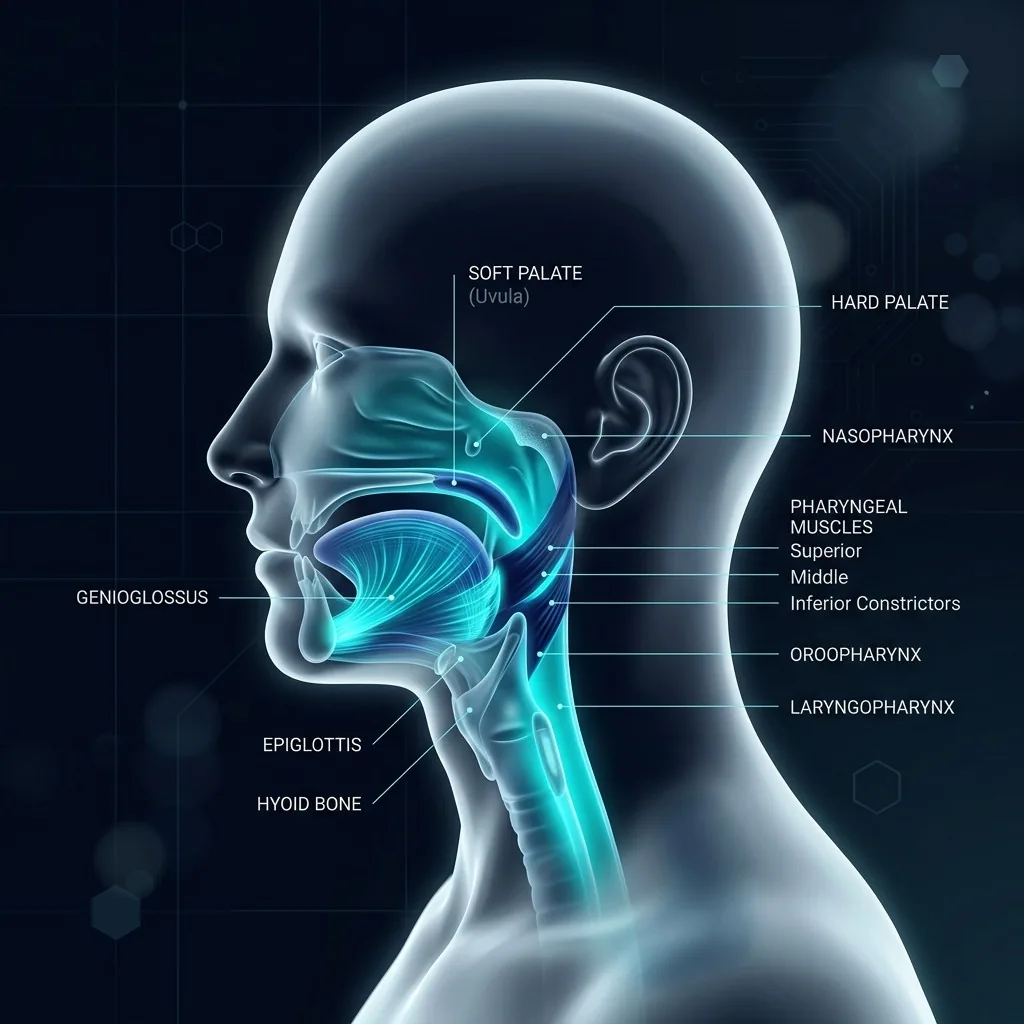
The soft palate is the flexible tissue behind the hard roof of your mouth. When you fall asleep, the muscles around the tongue, palate, and throat naturally relax. If the soft palate becomes too floppy, airflow can make it vibrate. That vibration is one common source of snoring.
That is why top-ranking guides do not only list "palate exercises." They include tongue presses, vowel sounds, cheek resistance, nasal breathing, and throat drills. The soft palate works as part of an airway system, so the best routine trains the surrounding muscles too.
Airway Trainer turns this into short guided sessions with reminders, timers, and progression, because the research pattern is boring but useful: consistency beats novelty.

Match the exercises to your snoring type
How you snore tells you which drills to start with. This is the same triage that ENT clinics use when handing out at-home palate exercises - it just rarely makes it into the listicles.
Open-mouth snoring
Signal: You wake with a dry mouth; partner says your jaw drops.
Likely cause: Weak throat tissue and a lost mouth seal at night.
Start with
- Yawn + cheek puff
- Lip purse / button hold
- Vowel holds
- Soft palate lift
Closed-mouth snoring
Signal: Lips stay closed but the snore is throaty or fluttery.
Likely cause: Tongue falls back and crowds the palate.
Start with
- Tongue slide
- Tongue-to-palate press
- Tongue aerobics
- Tongue stretch
Back-sleeper snoring
Signal: You only snore on your back, not your side.
Likely cause: Gravity collapses palate and tongue together.
Start with
- Any palate drill is fair game
- Pair with side-sleeping or a positional pillow
- Address weight, alcohol, and late meals
15 soft palate exercises for snoring
Start gently. These should feel like controlled mouth and throat drills, not a workout that leaves your jaw or neck sore. The first four are palate-specific drills pulled from clinical (NHS) handouts. The middle group is the highest-frequency drills from Sleep Foundation, SleepApnea.org, and ENT-clinic guides on page one. The last three are clinical demos from the Sengkang General Hospital (SingHealth) sleep unit's “Tabata Mayo” programme - a Tabata-format (20s work / 10s rest, 8 rounds, 4 minutes total) cycle through tongue pop, suction, and tongue-in-cheek.
Exercise 1
Soft palate lift ("ah" hold)
Soft palate and uvula control
- Open your mouth and make a clear, sustained "ah" sound.
- Watch in a mirror for the back of the palate and uvula to lift.
- Relax fully between reps so each lift is deliberate.
Form cue: You should feel movement high at the back of the mouth, not strain in the neck.
Exercise 2
Yawn + cheek puff (NHS palate drill)
Soft palate stiffness and seal
- Yawn fully, then close your lips and puff your cheeks out with air.
- Keep breathing in and out through your nose for 10 seconds.
- Lightly press your cheeks with a finger - keep the air trapped, no leaks through nose or mouth.
Form cue: Pulled directly from the Torbay & South Devon NHS soft-palate handout - one of the few drills built specifically for the palate.
Exercise 3
Straw blow with finger seal
Soft palate elevation under load
- Take a normal drinking straw and blow steadily through it.
- Cap the far end with your finger so air pressure builds against the palate.
- Hold the pressure for 5-10 seconds, breathe, repeat.
Form cue: NHS palate drill. Stop if you feel ear pressure or lightheadedness.
Exercise 4
Hum → stop → puff → "p"
Palate-lip coordination and timing
- Hum with lips closed for 2-3 seconds.
- Stop humming, then puff your cheeks with air.
- Release the air sharply with a clean "p" sound.
Form cue: A sequenced drill from clinical palate handouts. Order matters - it trains the palate to release pressure on cue.
Exercise 5
Vowel holds (A-E-I-O-U)
Palate, throat, and tongue coordination
- Say A, E, I, O, and U slowly and clearly.
- Exaggerate the mouth shape without shouting; repeat each vowel 10-20 times.
- Combine sounds (e.g. "ooo-aaah") for the last round.
Form cue: The vowel drill that appears in nearly every page-one guide (Sleep Foundation, SleepApnea.org, ENT clinics).
Exercise 6
Tongue-to-palate press
Tongue base and soft palate support
- Press the full tongue flat against the roof of your mouth.
- Hold for 10 seconds while breathing through your nose.
- Release, rest, and repeat with clean form.
Form cue: Keep the jaw relaxed. The tongue should do the work.
Exercise 7
Tongue slide
Upper tongue and palate contact
- Place the tip of your tongue behind your top front teeth.
- Slide the tongue backward along the roof of your mouth.
- Return to the starting point and repeat slowly.
Form cue: The single most common drill across the SERP - appears on every page-one result.
Exercise 8
Tongue stretch
Tongue length and base strength
- Stick your tongue out as far as it will comfortably go.
- Try to reach toward your chin while looking up at the ceiling.
- Hold, release, and gradually increase the duration over time.
Form cue: A staple of the Sleep Foundation and SleepApnea.org routines.
Exercise 9
Tongue aerobics (up/down/L/R)
Full tongue range and tone
- Stick out the tongue and reach up toward your nose - hold 10 seconds.
- Reach down toward your chin - hold 10 seconds.
- Push left, then right, holding each for 10 seconds. Repeat the cycle 10 times.
Form cue: From SleepApnea.org. Trains the tongue in the directions it falls during sleep.
Exercise 10
Lip purse / button hold
Mouth seal and lip strength (less mouth breathing)
- Purse your lips tightly as if to whistle and hold for 10 seconds.
- For a tougher version: tie a button to a string, place between lips and front teeth, and pull on the string while keeping the button trapped.
- Resist for 10 seconds, rest, repeat.
Form cue: A closed mouth at night = less palate flutter. The button-hold variant is from SleepApnea.org.
Exercise 11
Cheek puff with nasal breathing
Palate seal, cheeks, and nasal breathing
- Fill your cheeks with air while keeping your lips sealed.
- Breathe in and out through your nose for 10 seconds.
- Let the air out gently and reset.
Form cue: Stop if you feel pressure in your ears or dizziness.
Exercise 12
Gargle, hum, or singing drill
Soft palate endurance
- Gargle gently with water for ~30 seconds, or hum/sing simple scales.
- Focus on vibration and lift at the back of the mouth.
- Limited research suggests 3 months of focused singing reduces snoring frequency, severity, and loudness.
Form cue: Sound-based drills are the easiest to actually keep doing - pair with a daily activity like the shower. The Singing for Snorers programme (Alise Ojay, UK) found the strongest effect in older adults losing muscle mass.
Exercise 13
Tongue pop (SingHealth)
Tongue tone + palate-tongue rest position
- Open your mouth and place the tongue tip behind the upper front teeth, pressing the whole tongue up against the hard palate.
- Create suction between the tongue and the roof of the mouth and hold for ~1 second.
- Flick the tongue down sharply off the palate to make a clean "pop" sound.
Form cue: Demonstrated by the Sengkang General Hospital sleep unit. Aim for a crisp pop, not a wet click - that means real suction released, not just a lazy tap.
Exercise 14
Tongue suction hold (SingHealth)
Soft palate + tongue, palatal tongue rest position
- Open the mouth; place the tongue tip behind the upper front teeth.
- Press the rest of the tongue upward to the palate, sealing the entire tongue against it.
- Hold the suction for 10 seconds while breathing through the nose. Relax for 5 seconds, then repeat.
Form cue: The static partner to the tongue pop - same posture, no release. Trains the resting position experts want your tongue to default to at night.
Exercise 15
Tongue-in-cheek press (SingHealth)
Cheek + tongue tone, better mouth closure
- Push the tongue firmly into the inside of one cheek and hold for 10 seconds.
- You should feel a stretch on both the tongue and the cheek - resist with the cheek so it does not bulge outward.
- Relax for 5 seconds, then switch cheeks. Five sets per side.
Form cue: A lateral drill that the other lists skip. SingHealth pairs it with tongue pop and suction in their "Tabata Mayo" series - 20s on / 10s off, 8 rounds.
What an ENT actually looks at before recommending exercises
The page-one listicles all give you the same 8 to 12 drills as if every snorer has the same problem. ENT surgeons do the opposite - they figure out which part of your throat is collapsing first, then pick exercises for those muscles specifically.
The tool is called drug-induced sleep endoscopy (DISE): the surgeon gives a small dose of sedation, lets you fall asleep and start snoring, then watches the back of your throat with a flexible scope to see exactly what flaps, falls back, or rubs together. The four common collapse points line up with the VOTE framework - velum (soft palate), oropharynx (sidewall), tongue base, and epiglottis.
Vik Veer, an ENT surgeon in London, put a scope up his own nose to watch his throat while doing common snoring exercises. The argument he came away with is worth knowing if you are planning a routine:
Train muscles that open the airway
Tongue protrusion + depression (pushing forward and flattening). On endoscopy this visibly enlarges the space behind the tongue. The Inspire and Genio implants target the same nerves on purpose.
Be cautious with muscles that close it
Pulling the tongue backward, low-pitch gargle-style sounds, and anything that mimics a death-metal scream all narrowed his airway on camera. Useful to know what NOT to drill.
Lift the palate, then pull it forward
Repeatedly lifting the palate ("pumping iron with your palate" in a mirror) stiffens it. A separate sucking drill - like trying to draw a thick milkshake through an old plastic straw - pulls the palate forward, increasing the retropalatal space the same way surgery does.
Treat tongue tie as a real blocker
If your tongue tie (the frenulum under the tongue) prevents straight protrusion, the tongue rolls down instead of forward. Myofunctional therapists routinely refer these patients to surgeons for a frenectomy so the exercises can actually work.
Veer is careful to flag that this is endoscopic observation, not a randomized trial - but it is the closest thing on the public internet to watching what these exercises actually do inside the throat. The video is embedded below.
Pitch matters more than the page-one lists suggest
Every page-one guide tells you to do the A-E-I-O-U vowel drill. None of them mention that pitch changes what the airway does while you make the sound.
Veer found the same thing watching his own throat: high-pitched sounds open the airway; low-pitched sounds collapse it. A bright, tight “EEE” with the throat, neck, and palate muscles all engaged dilates the back of the throat. A low growl, a rumbling gargle, or the aggressive throat-scream that rock and metal vocalists use does the opposite - it rubs the sidewalls of the throat together. That sidewall rub is the same vibration that makes some snorers loud enough to wake people through two brick walls.
High-pitch drill (do this)
A clear, tense "EEE" or "I" with every muscle in the neck and throat engaged. 5-second holds, 10 reps. Adds open-airway training to your routine.
Low-pitch sounds (avoid as exercise)
Sustained low gargles, growls, or screaming-style vocal work. They can be fun, but they train the sidewall to clap together - the opposite of what a snorer wants.
Video walkthroughs
Use these for movement context. The first two are general routines that already rank in the SERP. The Vik Veer talk is the long-form clinical reasoning behind the “What an ENT looks at” section above. The SingHealth clip is the hospital sleep unit's tongue-pop demo with the timed protocol.
A 12-week routine (10-30 minutes a day)
The Ieto (2015), Guimaraes (2009), and Goswami (2019) trials all measured change at the 3-month mark. That is the realistic horizon. Aim for 10-30 minutes a day, split into 2-3 short sessions. A heroic routine you abandon after three days beats nothing - but it loses to a 10-minute routine you actually do.
Two timing notes from clinicians worth folding in: before bed seems to outperform morning for most patients (Veer), and a Tabata format - 20 seconds work / 10 seconds rest, 8 rounds, 4 minutes total - is exactly how the SingHealth sleep unit structures its “Tabata Mayo” sessions. If a 20-minute routine feels unreasonable, two 4-minute Tabata blocks (morning + bed) is a defensible floor.
Veer also notes that improvement often starts to show around 3 weeks (muscle response), not 12 - but the published trial endpoints sit at 3 months, so that's the horizon to plan around. Around half of patients see a meaningful reduction in snoring; a smaller group sees full resolution; some see no benefit at all because the driver is anatomy, not muscle tone.
Weeks 1-3
Learn the movements with a mirror. Light effort, ~10 min/day.
Weeks 4-6
Add a second session. Increase hold times and rep counts.
Weeks 7-9
Layer palate + tongue + nasal-breathing drills together.
Weeks 10-12
Audit results: snoring app data, partner feedback, daytime energy.
If you want the lowest-friction version, use Airway Trainer for the daily sequence. It gives you the reps, timers, and progression without asking you to keep a handout open.


When soft palate exercises won't be enough
Page-one guides are honest about a fact most listicles bury: exercises are most effective for mild snoring with a muscular cause. They tend to underperform when the driver is something else. Specifically:
Alcohol or sedatives
Muscles relax past what training can offset.
Large tonsils or anatomy
Physical obstruction needs ENT evaluation.
Severe nasal blockage
Treat the nose first (allergies, deviated septum).
Significant weight gain
Airway narrowing from soft tissue mass.
Untreated moderate/severe OSA
Exercises support, not replace, CPAP or therapy.
Jaw position issues
May benefit from a mandibular advancement device.
Fit 20-year-old with normal muscle mass
Veer notes the strongest responders are older adults losing 3% muscle mass per year. Younger snorers with healthy tone may need less drilling and more habits - nasal breathing, side sleeping, alcohol timing.
Restrictive tongue tie
A short frenulum prevents straight tongue protrusion. Refer for evaluation before drilling further.
Snoring can also be a sign of obstructive sleep apnea. Get evaluated if you have gasping, choking, witnessed pauses in breathing, morning headaches, high blood pressure, or heavy daytime sleepiness. Start with our free sleep apnea quiz to check common warning signs - exercises can support care, but they should not replace a sleep apnea diagnosis or treatment.
Evidence and sources
The current top-ranking pages lean on clinical credibility. This article cites the same evidence family: oropharyngeal and myofunctional therapy studies, plus a soft palate and tongue exercise handout.
- Ieto V, et al. Chest. 2015 Sep;148(3):683-691.
Randomized trial: oropharyngeal exercises reduced snoring frequency and snoring power. - Guimaraes KC, et al. Am J Respir Crit Care Med. 2009 May 15;179(10):962-968.
Randomized trial: upper-airway exercises improved obstructive sleep apnea outcomes. - Goswami U, et al. Sleep Breath. 2019 Mar;23(1):243-250.
Smartphone-guided oropharyngeal exercise delivery for snoring. - Cochrane Database Syst Rev. 2020.
Review: myofunctional therapy for obstructive sleep apnea. - Torbay and South Devon NHS Foundation Trust.
Patient handout: soft palate and tongue exercises. - Veer V. ENT Surgeon, London. YouTube clinical walkthrough.
ENT-surgeon endoscopy of palate, tongue, and sidewall during exercises - argues for training the specific muscles that open the airway. - Sengkang General Hospital (SingHealth) Sleep Unit.
Clinical "Tabata Mayo" video series demonstrating tongue pop, tongue suction, and tongue-in-cheek drills with timed protocols.
Keep the routine organized
The Airway Trainer app overview shows how these palate, tongue, and throat drills fit into a guided six-week plan. For the full airway training for snoring program framing, start there. You can also use the free snoring score tool to capture a baseline and compare changes over time, or the sleep cycle calculator to plan wake-up times that fit a consistent morning-and-evening practice.
Soft palate exercises for snoring FAQs
Can soft palate exercises stop snoring?
They may reduce snoring when a relaxed or fluttering soft palate is part of the problem. They are less likely to fix snoring caused mainly by nasal blockage, large tonsils, alcohol, weight-related airway narrowing, or untreated sleep apnea.
How long do soft palate exercises take to work?
The research consensus across page-one guides is around 3 months (12 weeks) of practice for 10 to 30 minutes a day, ideally split across 2 to 3 sessions. Some people notice less snoring sooner, but the evidence base from oropharyngeal exercise trials uses the 3-month mark for measurable change. Daily consistency matters far more than any single hard session.
How often should I do soft palate exercises?
Aim for 10 to 30 minutes total per day, broken into 2 or 3 short sessions. That matches what the Sleep Foundation, SleepApnea.org, and the Ieto et al. trial all recommend. A 5-minute morning round and a 5-minute evening round is realistic and sustainable.
What is the best exercise for sleep apnea snoring?
No single drill wins. The strongest evidence is for combined oropharyngeal routines that train the tongue, soft palate, throat, and nasal breathing together - that is what was tested in the Guimaraes (2009) and Ieto (2015) randomized trials. If you can only pick one, the tongue slide and the soft palate "ah" lift are the highest-leverage drills.
Does singing actually reduce snoring?
Limited but encouraging evidence: small trials suggest 3 months of focused singing training can lower snoring frequency, severity, and loudness, especially for mild snoring. The mechanism is the same - repeated, deliberate use of palate, throat, and tongue muscles strengthens the airway.
Who do soft palate exercises NOT work for?
Exercises tend to underperform when snoring is driven by alcohol or sedatives (the muscles relax past what training can offset), large tonsils or anatomical obstruction, severe nasal blockage, significant weight-related airway narrowing, or moderate-to-severe untreated sleep apnea. In those cases, exercises can still help, but they are an add-on rather than a primary treatment.
Are soft palate exercises the same as mouth exercises for snoring?
Soft palate exercises are one part of mouth and throat training. A complete routine usually also includes tongue, cheek, lip, throat, and nasal-breathing drills.
Should I do every exercise or only the ones for my collapse pattern?
Generic listicles say "do all of them." ENT surgeons like Vik Veer (London) make the opposite case after watching their own throat on endoscopy: train the muscles that open the airway (tongue protrusion + depression, palate lift, palate pull-forward, high-pitch vowels) and be cautious about exercises that mimic the collapse pattern (tongue pulled backward, low-pitch growling, sidewall rubbing). If you do not know your collapse pattern, our "Match the exercises to your snoring type" section is the closest you can get without a drug-induced sleep endoscopy.
Does pitch really matter when I do the vowel drill?
Yes. High-pitched sounds like a tight "EEE" with the neck and throat tensed dilate the airway on endoscopy. Low-pitched sounds - sustained gargles, growls, screaming-style vocals - collapse the sidewall and narrow the airway. The page-one A-E-I-O-U drill is fine if you exaggerate the high vowels and the muscle tension. Skip the low-pitch growls as a training tool.
What is the SingHealth "Tabata Mayo" approach?
It is a Tabata-format myofunctional routine published by the Sengkang General Hospital sleep unit in Singapore: 20 seconds of work, 10 seconds of rest, 8 rounds, 4 minutes total. They run it for tongue pop, tongue suction, tongue-in-cheek, and air puff drills. Two Tabata blocks per day (morning and before bed) is a reasonable minimum routine if a 20-minute daily session is unrealistic.
Why is my tongue tie making these exercises harder?
A short lingual frenulum (the band of tissue under the tongue) limits how far the tongue can move forward. Instead of protruding straight out, the tongue rolls down - exactly the opposite of what these drills are training. Myofunctional therapists routinely refer patients with a restrictive tongue tie to an oral surgeon or ENT for a frenectomy so the exercises can actually work.
Should I use a snoring app or a PDF?
A PDF can show the movements, but an app is better for guided reps, reminders, progression, and consistency. That matters because airway exercises work more like physical therapy than a one-time trick.
When should I talk to a doctor?
Talk to a clinician if you gasp or choke at night, have witnessed pauses in breathing, wake with headaches, feel very sleepy during the day, or have high blood pressure. Exercises can support care, but they should not replace sleep apnea diagnosis or treatment.
Train the soft palate, tongue, and throat in one guided routine
Airway Trainer gives you a 5-minute daily plan, exercise timers, and progression so the hard part is not remembering what to do next.