Singing exercises for snoring
Not karaoke as a miracle cure - targeted vocal drills with real trials behind them. Here is how singing can tone soft-palate and throat muscles, what the Ojay pilot and Hilton RCT actually found, who is a realistic candidate, and when quieter oropharyngeal exercises cover the same idea without a songbook.


Quick answer
Yes for some snorers - especially age-related floppy throat tissue - with caveats. Structured singing exercises are one of the few musical interventions tested for snoring. Ojay and Ernst (2000) saw less recorded snoring after 3 months of daily practice. Hilton and colleagues (2013) ran a randomized UK trial and found better daytime sleepiness and lower snoring frequency versus control after a 3-month home singing program.
The mechanism is airway muscle training, not magic pitch. If you will not practice, have severe untreated apnea, or mainly need nasal or surgical care, this is the wrong first tool. The same training idea also shows up in structured oropharyngeal exercise studies and in the sibling didgeridoo for snoring evidence path.
How singing exercises train the airway
Snoring is soft tissue vibrating in a narrowed throat. Sleep already drops tone in the tongue, soft palate, and pharyngeal walls. As people age, that loss of tone can be enough to start a new snoring habit even without childhood trench snoring.
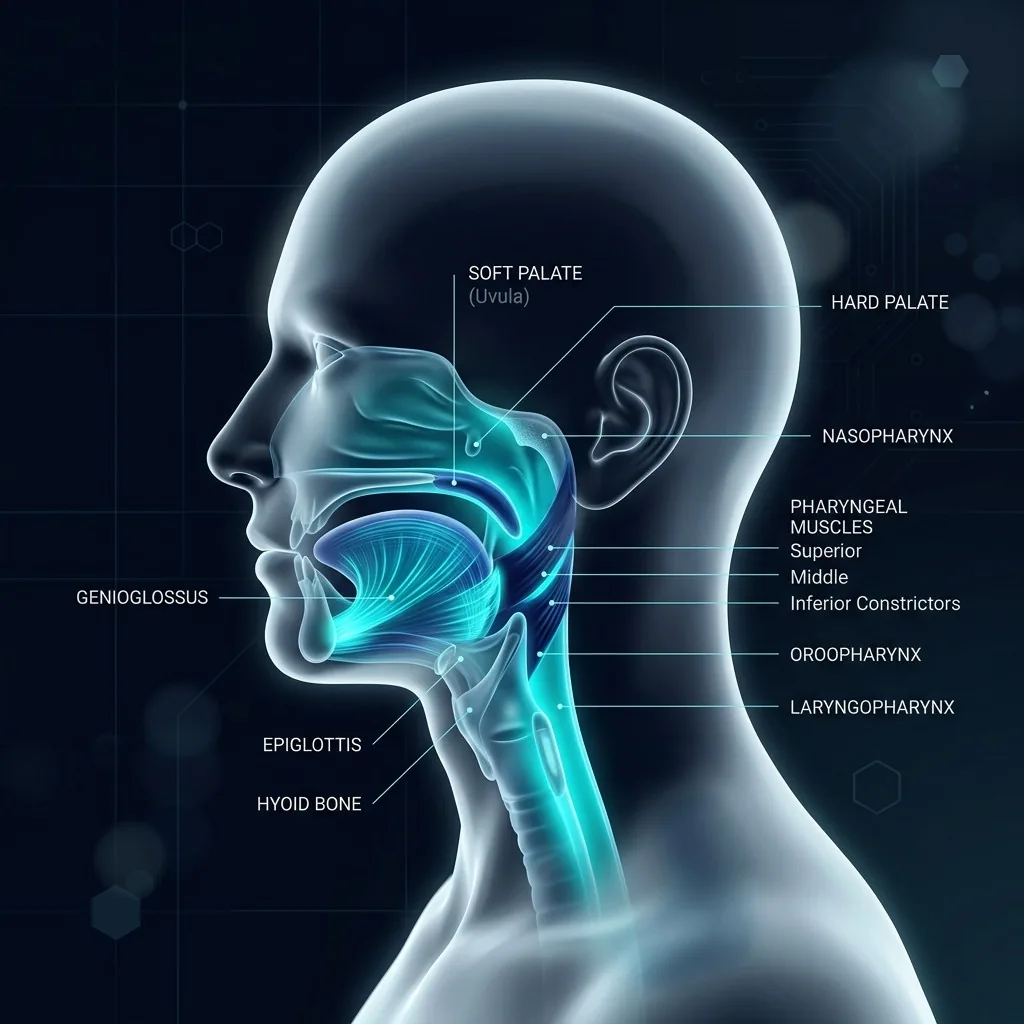
Singing programs built for snorers do not aim for concert polish. They use short, repetitive sound combinations that load the soft palate, tongue, nasal airflow path, and pharyngeal arches - the common vibration sites. Choir directors and ENT clinicians who promote the approach describe it as local strength work for the same tissues that flutter at night. Demonstration videos are framing, not proof; trial outcomes live in the Sources list.
Primary singing target
Soft palate and pharyngeal arch tone
Singing programs for snorers repeatedly load the soft palate and the arches at the back of the mouth with short, precise sound patterns. The goal is stiffer tissue that flutters less when airflow turns turbulent at night.
Shared with myofunctional work
Tongue and floor-of-mouth support
Pitch and vowel shapes recruit tongue posture and floor-of-mouth muscles that help hold the tongue base forward. That overlaps with tongue drills studied in oropharyngeal exercise trials, packaged as musical repetitions instead of silent holds.
Coordination load
Breath control under the voice box
Singing demands steady subglottal pressure and coordinated laryngeal, diaphragm, and accessory breathing muscles. Sleep researchers note that kind of training may raise resting upper-airway tone, though objective tone measurements are still sparse in singing trials.
Not a universal cure
What singing does not fix
Singing will not unclog a severely blocked nose, shrink large tonsils, reverse major jaw anatomy, or replace CPAP for people who need positive pressure. Lifelong heavy snorers and people with obesity outside the best-response profiles in early studies often need a broader plan.
What the trials showed
Ojay and Ernst (2000) ran a pilot in chronic snorers (n=20). People learned singing technique and practiced about 20 minutes a day for 3 months. Snoring duration from multi-night tape recordings fell on average, with the biggest gains in people who practiced accurately, were not overweight, had no major nasal problems, and began snoring in middle age rather than lifelong heavy snoring.
Hilton and colleagues (2013) tested a structured Singing for Snorers program in a randomized controlled trial at Royal Devon and Exeter NHS. Adults with simple snoring or mild-to-moderate sleep apnea were assigned to daily home singing exercises for 3 months or to a control path. Versus control, the singing group improved Epworth sleepiness (difference about -2.5 points) and snoring frequency (difference about -1.5 on a 0-10 scale). Loudness trended better but was not statistically significant. About 93 of 127 recruited people completed follow-up; outcomes were subjective ratings rather than full polysomnography endpoints.
Pai and colleagues (2008) compared semi-professional choir singers with non-singers. After adjusting for age and BMI, singers had lower partner-rated snoring scores. Daytime sleepiness did not differ. That is observational signal, not a training trial.
A 2020 systematic review (van der Weijden et al.) pooled wind-instrument and singing studies. Descriptive findings favored double-reed players, didgeridoo practice, and singers; the formal meta-analysis effect was zero-to-small with low certainty. The authors still called singing and didgeridoo the most practical options in that niche literature for snoring and OSA respectively.
Read the numbers with adult skepticism. Sample sizes are modest, blinding is hard when the treatment is singing, and objective snore power or AHI endpoints are thinner than in some oropharyngeal exercise trials. Singing is a promising training format, not a license to abandon prescribed therapy.
Later myofunctional and oropharyngeal exercise research (Guimaraes 2009, Ieto 2015, Camacho 2015 meta-analysis) expands the same muscle-training idea with structured drills instead of music. Those programs report snoring and AHI improvements in selected adults, again with study-size and adherence limits.
Who singing practice is for
Best-fit profile (closest to the evidence)
- Primary snoring or mild-to-moderate OSA after a real sleep evaluation
- Snoring that started or got worse in midlife with softer throat tissue, not childhood trench-snoring alone
- Willingness to practice about 12-20 minutes most days for 3 months
- You want a fun training path and will actually finish the program
Weaker or unclear fit
- Severe untreated OSA, especially with cardiovascular risk
- Main problem is fixed nasal blockage, large tonsils, or major jaw anatomy
- BMI and comorbidities far outside what small singing studies enrolled
- You will not practice, or household noise rules block any vocal work
See a clinician first if...
- Gasping, choking, or witnessed breathing pauses
- Severe daytime sleepiness, morning headaches, or resistant high blood pressure
- You already use CPAP and adherence or mask issues are the real problem
- Voice, throat pain, or ear problems appear when you try vocal exercises
How people actually practice (trial-style dose)
You do not need to sound good. You need consistent airway load on the tissues that snore. Programs studied for snoring start simple, grade the difficulty, and aim for months of short daily work.
Week 1
Start gentle and graded
Beginner singing-for-snoring programs start with simple sound patterns, not advanced choir repertoire. Short sessions beat heroic first days that trash your voice.
Weeks 2-8
Hit the nightly sites on purpose
Programs built for snorers emphasize soft palate, tongue, nasal airflow, and the palatopharyngeal arch - the common vibration sites - with repetitive short combinations rather than random karaoke.
Months 1-3
Build toward a trial-style dose
Ojay pilot work used about 20 minutes a day for 3 months. Hilton RCT participants used a self-guided video with similar daily targets; median compliance was solid when people stuck with it. Expect weeks, not one viral clip.
Ongoing
Track partner noise and sleepiness
Log snoring frequency/loudness with a bed partner rating and note daytime sleepiness. If red-flag apnea symptoms appear or worsen, stop self-experimenting and get evaluated.
This is educational, not voice coaching or medical advice. If singing hurts your throat, jaw, or ears, stop and check with a clinician before continuing.
Expert videos on singing, snoring, and airway training
Demonstration and clinician framing only. Clinical claims on this page are grounded in the Sources list, not in video captions.
Vik Veer, NHS ENT surgeon - how Singing for Snorers sparked his interest in airway exercises, and which snorers (new midlife onset) tend to respond better than lifelong heavy snorers.
Alise Ojay (Singing for Snorers) - creator overview: graded sing-along patterns aimed at soft palate, tongue, nasal path, and pharyngeal arch, plus a plain-language nod to the later RCT.
Local news interview - Ojay discussing trial size, simple snoring vs mild-moderate apnea wings, and why age-related loss of throat tone is the main design target.
Adam Fields, DC - long tongue, lip-seal, soft-palate, and open-throat sequence that bridges singing posture work and silent myofunctional drills.
Vik Veer, NHS ENT surgeon - research-picked tongue and throat drills when you want the muscle load without a full singing curriculum.
Quieter alternative: the same idea without the songbook
If the music is the fun part for you, lean into a graded singing program and keep the dose close to the trials. If singing is the barrier - voice anxiety, roommates, travel - remember what the studies are really testing: repeated training of collapsible airway muscles.
Structured oropharyngeal and myofunctional programs train tongue posture, soft palate lift, and throat walls with short daily drills. Randomized work includes reduced snoring power (Ieto 2015) and improved OSA metrics versus sham (Guimaraes 2009). Camacho's 2015 meta-analysis pooled adult myofunctional studies and found roughly half the starting AHI on average, with snoring and sleepiness gains too. Those are not singing clones, and study quality still varies - but they are the practical twin of the musical approach.
A sensible stack for many snorers: rule out red-flag apnea, fix obvious nasal blockage when present, try side sleep if back sleep is loud, limit late alcohol, then pick one training path you will finish - singing, didgeridoo, or guided tongue/palate/throat work. Deep-dive guides: tongue exercises, soft-palate drills, throat exercises, and the clinical studies roundup.
Airway Trainer packages those drills into a guided daily session when a singing curriculum is not practical - same muscle-training goal, no late-night rehearsals required.
When to see a doctor first
Buying a vocal program is not a sleep evaluation. Get medical care - do not only start a hobby - if you have:
- Gasping, choking, or witnessed pauses in breathing
- Loud snoring with severe daytime sleepiness or nodding off
- Morning headaches or resistant high blood pressure
- Known moderate-severe OSA and you are thinking of quitting CPAP
Singing practice, guided airway exercises, positional therapy, oral appliances, weight management, nasal care, and CPAP each solve different pieces. Match the tool to the cause after a real assessment when red flags are present.
Sources
- Ojay A, Ernst E. Complement Ther Med. 2000 Sep;8(3):151-156. PMID: 11068344.
Pilot study (n=20 chronic snorers): singing technique plus ~20 minutes daily exercises for 3 months reduced recorded snoring duration on average, especially with accurate practice, non-obesity, no nasal problems, and middle-age onset snoring. - Hilton MP, et al. Int J Otolaryngol Head Neck Surg. 2013;2(3):97-102. doi: 10.4236/ijohns.2013.23023.
Randomized controlled trial at Royal Devon and Exeter NHS (n=127 recruited, 93 completed): 3 months of daily Singing for Snorers exercises improved Epworth sleepiness vs control (difference about -2.5), reduced snoring frequency (difference about -1.5 on a 0-10 scale), and showed a non-significant trend toward quieter snoring. Outcomes were subjective (no objective snore power or full PSG endpoints). - Pai I, et al. Sleep Breath. 2008 Aug;12(3):265-268. PMID: 18183444.
Cross-sectional comparison: semi-professional choir singers had lower partner-rated snoring scale scores than non-singers after adjustment for age and BMI; daytime sleepiness (Epworth) did not differ. - van der Weijden FN, Lobbezoo F, Slot DE. J Clin Sleep Med. 2020 Sep 15;16(9):1591-1601. PMID: 32536365.
Systematic review and meta-analysis of wind instruments and singing for snoring/OSA risk: descriptive signals favor double-reed players, didgeridoo, and singers; pooled meta-analysis effect was zero-to-small with low certainty. Authors call didgeridoo and singing the most practical candidates in that literature for OSA and snoring respectively. - Camacho M, et al. Sleep. 2015 May 1;38(5):669-675. PMID: 25348130.
Meta-analysis of myofunctional (oropharyngeal) therapy for OSA: pooled adult studies showed roughly 50% AHI reduction plus snoring and sleepiness gains - the same muscle-training idea without requiring a song program. - Ieto V, et al. Chest. 2015 Sep;148(3):683-691. PMID: 25950418.
Randomized trial: oropharyngeal exercises reduced objective snoring frequency and snoring power in habitual snorers. - Guimaraes KC, et al. Am J Respir Crit Care Med. 2009 May 15;179(10):962-968. PMID: 19234106.
Randomized trial: daily upper-airway exercises improved OSA outcomes versus sham therapy. - Mayo Clinic. Snoring: Symptoms and causes / Obstructive sleep apnea.
Clinical context: snoring and OSA come from collapsible upper-airway tissue; lifestyle, devices, CPAP, and surgery are standard paths. Muscle-training approaches sit alongside evaluation when apnea red flags appear.
Singing exercises for snoring: FAQs
Do singing exercises help snoring?
They can for some people. A 2000 pilot study found reduced recorded snoring duration after 3 months of daily singing exercises, especially in non-obese, compliant people with middle-age onset snoring. A later randomized UK trial (Hilton 2013) found better Epworth sleepiness and lower snoring frequency versus control after 3 months of a structured singing program, though outcomes were mostly subjective. Results are not guaranteed, and severe apnea still needs medical care.
How does singing reduce snoring?
The leading idea is upper-airway muscle training. Precise pitch, vowel shapes, and soft-palate work repeatedly load the tissues that go floppy in sleep. Stronger, better-coordinated palate, tongue, and pharyngeal walls may vibrate less when airflow turns turbulent. This is the same broad mechanism behind oropharyngeal and myofunctional exercise programs studied without music.
How long do you need to practice singing exercises for snoring?
Published programs typically aim for daily practice over about 3 months, often around 12-20 minutes once you know the patterns. The Ojay pilot used about 20 minutes a day. There is no proven one-weekend shortcut. Adherence matters more than perfect pitch.
Is singing better than didgeridoo or throat exercises for snoring?
They target overlapping muscles with different packaging. A 2020 systematic review called singing and didgeridoo the most practical candidates in the wind/singing literature for snoring and OSA respectively, with low overall certainty. Oropharyngeal exercise trials (Ieto 2015, Guimaraes 2009) and a myofunctional meta-analysis (Camacho 2015) support structured tongue, palate, and throat drills without an instrument or songbook. Choose the format you will finish.
Can I get the benefits without joining a choir?
Yes. Clinical programs studied home sing-along or video-guided exercises, not only professional choir practice. Quiet guided tongue, soft-palate, and throat drills try to deliver a similar muscle-training load without requiring you to sing. You lose the hobby angle, but you keep the training idea that several clinical programs study.
Is singing safe if I have sleep apnea?
Mild-to-moderate snoring and OSA cohorts appear in the singing literature, but singing is not clearance to drop prescribed CPAP or to self-treat severe apnea. Get a diagnosis, talk with your clinician before changing therapy, and stop if you feel lightheaded, dizzy, or develop voice or throat pain.
When should I see a doctor instead of starting a singing program?
See a clinician for gasping, choking, witnessed pauses, severe sleepiness, morning headaches, resistant high blood pressure, or loud snoring that continues despite lifestyle changes. A quieter hobby is not a sleep study. Use STOP-BANG or similar screens only as a nudge toward care, not as a diagnosis.
Train the airway - with music or without
Singing trials are a memorable proof that upper-airway muscles respond to practice. Airway Trainer keeps that training idea in a quiet, guided routine when a full vocal program is not the right tool for your home.
Related reading: Didgeridoo for snoring · Oropharyngeal exercise studies · Throat exercises for snoring