A new model shows why the soft palate snores
Most snoring research chases sleep apnea. On 18 August 2026, engineers at KTH Royal Institute of Technology published a 3D model of the other problem: ordinary palatal snoring, the flutter that wakes a partner even when the airway never fully closes. Here is what the simulation actually found, and what it does not prove.


1. What the KTH model measured
2. Push-pull sound, not turbulence
3. What the authors will not prescribe
4. How this sits next to exercise trials
5. Who should see a doctor first
6. Frequently asked questions
Physics of Fluids published the KTH model of palatal, non-apneic snoring (open access, CC BY).
Two-way fluid-structure interaction: airflow moves the palate, and the moving palate changes the airflow.
The dominant sound source in this simplified, open-airway model. A monopole term still mattered. A quadrupole (turbulence) term did not.
The palate settled into a self-sustained, repeating oscillation, which the authors treat as a snoring-like regime.
What the study measured
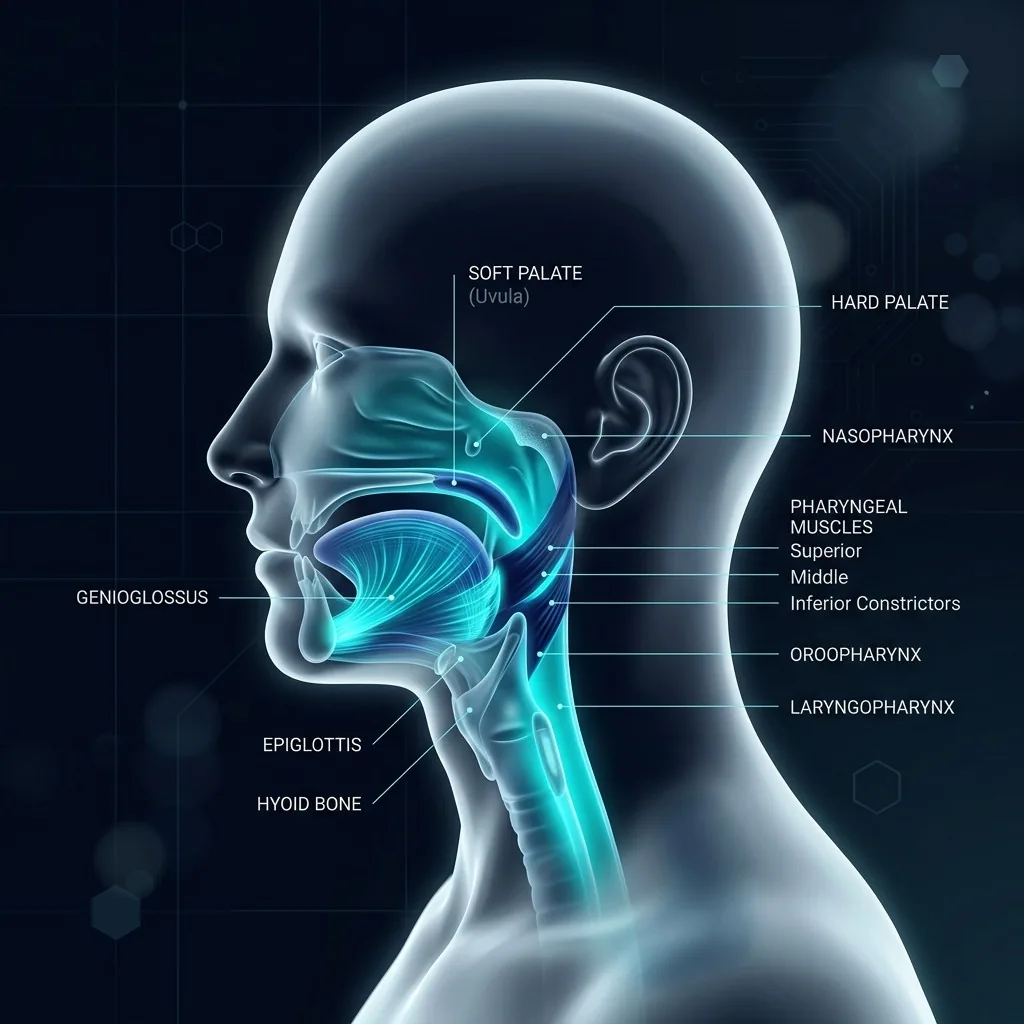
Peng Li, Marco Laudato, and Mihai Mihaescu, in the FLOW lab at KTH in Stockholm, built a two-way fluid-structure model of the human uvulopalatal system. Air pushes on the soft palate. The palate moves. That motion changes the airflow. Earlier models often froze the tissue walls. This one lets the two talk.
The target is specific: palatal non-apneic snoring. The airway stays open. The palate still flutters. That is a large share of household snoring, and it is not the same question as obstructive sleep apnea, where the airway repeatedly closes.
What the model actually reports
What they modeled
A simplified uvula and soft palate inside an upper-airway tube, with two-way coupling between air and tissue. Not a CT scan of a real patient.
What kind of snoring
Palatal, non-apneic snoring: the airway stays open, the palate still flutters. They did not model collapse or apnea events.
Where the sound comes from
A dipole source (push-pull between airflow and moving tissue) dominated. A monopole contribution remained relevant. A quadrupole source was negligible at the low Mach number they used.
How the palate moved
Nonlinear analysis showed a self-sustained limit-cycle oscillation. That is the physics of a reed that keeps sounding as long as air keeps flowing, not a one-off flap.
Crossref lists the article as created on 18 August 2026. It is open under a Creative Commons Attribution license. Volume 38, article 081909, in Physics of Fluids.
The sound is a push-pull, not a roar of turbulence
Popular explainers often say snoring is turbulent air rattling loose tissue. For this palatal, open-airway case, the KTH abstract points somewhere else. The dipole source dominated. A monopole term still contributed. The quadrupole source, the classic turbulence bucket in aeroacoustics, was negligible at the low Mach number they considered.
In plain language: the loud part is the tissue and the air shoving each other as the breath pulses, more like a reed than like water crashing in a pipe. The palate did not just flop once. It locked into a repeating, self-sustained oscillation.
The AIP journal release adds the authors' own gloss. Peng Li said many existing studies simplify breathing or skip the interaction between airflow, tissue motion, and sound. In their run, the loudest sounds came from unsteady airflow across the soft tissues of the mouth. Reducing soft-palate vibration or unsteady aerodynamic loading, Li said, may help reduce palatal snoring, and that could inform evaluation of palatal stiffening procedures or other interventions that modify tissue mechanics or airflow.
That last sentence is a research hint, not a shopping list. The same release says the model is still too simplified to offer detailed recommendations. Next they plan to vary palatal stiffness and watch amplitude, frequency, airflow, and source strength. If you want a map of which tissue is making the noise in a real bedroom, start with what your snoring sound reveals about the airway. That page is the clinical VOTE decoder. This page is the 2026 physics paper.
Train the tissue the model is vibrating
Airway Trainer is daytime work for the tongue, soft palate, and throat. It is not a treatment the KTH simulation tested. It is the same muscle group the paper spends 3D compute on.
What holds up, and what the paper will not carry
- It is a peer-reviewed, open-access paper in Physics of Fluids, not a press-release-only claim.
- It isolates ordinary palatal snoring, the bed-partner problem most consumer pages skip in favor of apnea.
- The authors say out loud that the model is too simple for treatment recipes. That honesty is useful.
- The next planned run (vary palatal stiffness) matches a question clinicians already ask: does a firmer palate flutter less?
- This is a computer model with simplified geometry, not a randomized trial in people.
- Pharyngeal walls were not treated as fully realistic, compliant tissue. Real throats absorb energy the model may miss.
- It does not prove that daytime exercises, strips, tape, or surgery will change your snore.
- It does not replace a sleep test when gasping, pauses, or heavy daytime sleepiness are in play.
A June 2026 Umea paper asked a different question: whether snoring vibrations damage airway muscle cells. That is biology, not aeroacoustics. Do not mash the two studies into one story. We cover the muscle-damage paper separately in snoring damages your airway muscles.
Exercises still rest on older trials, not this model
If the physics hint is "a less fluttery palate may be quieter," the clinical evidence for training those muscles is older and separate. A 2015 randomized trial in Chest (Ieto and colleagues) put adults on three months of daily oropharyngeal exercises. Snoring frequency fell about 36%. Snoring power fell about 59%. Guimaraes 2009 tested a related routine in moderate obstructive sleep apnea. Camacho 2015 pooled myofunctional-therapy trials.
None of those trials used the KTH simulation. Do not read the 2026 paper as a new proof that an app works. Read it as a clearer picture of why palatal flutter makes the sound it makes. For the drills themselves, use soft palate exercises for snoring. For the wider trial list, see oropharyngeal exercises: clinical studies.
See a doctor first if snoring is loud, if a partner has seen gasping or pauses, or if you wake exhausted. Those are apnea warning signs. This model cannot sort them for you.
Video context (not evidence)
These clips show anatomy, palatal flutter, and daytime drills. They are demonstration and framing only. They are not citations for the KTH results.
Daniel P. Slaughter, MD. Causes of snoring animation. Framing only.
Fauquier ENT. Palatal snoring defined as abnormal flutter. Procedure footage is not a recommendation.
Vik Veer, ENT surgeon, London. Endoscopic exercise walkthrough.
Sengkang General Hospital / SingHealth sleep unit. Tongue suction drill. Demonstration only.
Frequently asked questions
What did the August 2026 Physics of Fluids study find?
Researchers at KTH Royal Institute of Technology built a two-way, three-dimensional computer model of the uvula and soft palate. In this simplified, open-airway setup for non-apneic palatal snoring, the dominant sound source was a dipole (a push-pull between airflow and moving tissue). A monopole contribution still mattered. A quadrupole source, the turbulence bucket, was negligible at the low air speeds they modeled. The palate settled into a self-sustained, repeating oscillation, which the authors treat as a snoring-like regime. The paper is open access (doi 10.1063/5.0346307).
Does this prove mouth exercises stop snoring?
No. It is a simplified simulation, not a clinical trial. The authors say the model is too simple to prescribe treatments. Exercise evidence still comes from separate trials, including Ieto 2015 in Chest (snoring frequency down about 36% and snoring power down about 59% after three months of daily oropharyngeal exercises in a randomized study). Those trials did not use this KTH model.
What is palatal snoring?
It is snoring whose sound comes mainly from the soft palate and uvula fluttering as you breathe. Clinicians often call that site the velum. Fluttery or buzzy noise is a clue, not a diagnosis. Other sites (sidewalls, tongue base, epiglottis) can dominate instead. Use sound as a starting map, then get evaluated if warning signs are present.
Is this about sleep apnea?
Not directly. The model is for non-apneic palatal snoring: a patent airway that still makes noise. The authors did not model collapse, tissue contact, or apnea events. Loud snoring with gasping, witnessed pauses, or heavy daytime sleepiness still needs a clinician and, if indicated, a sleep test.
Why does the paper mention palatal stiffening?
The authors' own next step is to vary how stiff the palate is in the model, to see how stiffness changes vibration and sound. In the AIP release they say reducing palate vibration or unsteady aerodynamic loading may help, and that this could inform evaluation of palatal stiffening procedures or other interventions that change tissue mechanics or airflow. That is a research direction, not a recommendation to get a procedure.
Should I see a doctor about my snoring?
Yes, if snoring is loud, if someone has seen you gasp or stop breathing, or if you wake unrefreshed. This article cannot tell palatal flutter from obstructive sleep apnea. Get evaluated before you self-treat.
How is this different from the 2026 Umea muscle-damage study?
Different question. The KTH paper is physics: how the sound of palatal snoring is generated in a computer model. The Umea work in Mitochondrion looked at whether snoring vibrations damage airway muscle cells. One does not prove the other. See our separate explainer on snoring and airway-muscle damage.
Sources
- Li P, Laudato M, Mihaescu M. Computational analysis of palatal non-apneic snoring sound generation using a simplified human upper-airway model. Phys Fluids. 2026;38(8):081909.
Primary paper. Two-way 3D FSI model, dipole-dominant sound, limit-cycle palate motion.
- AIP Publishing. Making snoring a bit more palatable. 18 August 2026.
Journal press release with author quotes on vibration, aerodynamic loading, and palatal stiffening as a next modeling step.
- Ieto V, et al. Effects of oropharyngeal exercises on snoring: a randomized trial. Chest. 2015 Sep;148(3):683-691. PMID: 25950418.
Separate clinical evidence for daily oropharyngeal exercises and snoring, not derived from the KTH model.
- Guimaraes KC, et al. Effects of oropharyngeal exercises on patients with moderate obstructive sleep apnea syndrome. Am J Respir Crit Care Med. 2009 May 15;179(10):962-968. PMID: 19234106.
Randomized trial of oropharyngeal exercises in moderate OSA. Cited only as background for the exercise section.
- Camacho M, et al. Myofunctional therapy to treat obstructive sleep apnea: a systematic review and meta-analysis. Sleep. 2015 May 1;38(5):669-675. PMID: 25348130.
Pooled myofunctional-therapy trials. Not a test of the 2026 physics model.
Start a short palate routine
The physics paper is not a workout plan. The Ieto trial was three months of daily oropharyngeal work. Airway Trainer walks that kind of session, a few minutes at a time.
Medical disclaimer: this article is for education and does not replace medical advice. The 2026 Physics of Fluids paper is a simplified computer model of non-apneic palatal snoring, not a trial of any product, drug, or procedure. Loud snoring with gasping, witnessed pauses in breathing, or heavy daytime sleepiness should be checked by a clinician before any self-treatment.