Foundayo for sleep apnea
A once-daily oral GLP-1 just posted phase 3 OSA wins in JAMA - with clear AHI drops versus placebo over 52 weeks, with and without PAP. Here is what ATTAIN-OSA actually showed for Foundayo (orforglipron), how it differs from Zepbound and AD109, and what still matters for residual snoring.


Quick answer
Foundayo (orforglipron) lowered breathing-event rates more than placebo in two phase 3 OSA trials published in JAMA on November 9, 2026. Across 712 randomized adults with moderate-to-severe OSA and BMI of at least 27, once-daily oral orforglipron beat placebo on AHI at 52 weeks both without PAP (mean change -17.8 vs -4.5 events/hour) and with PAP (-17.3 vs -5.3). Company presentations also reported large relative AHI cuts from baseline, lower hypoxic burden, about 28 lb average weight loss, and improvements in blood pressure and inflammation markers.
An OSA-specific U.S. label is still a regulatory step, not a finished decision. Tirzepatide (Zepbound) remains the labeled weekly incretin for moderate-to-severe OSA with obesity. Neither drug replaces a sleep diagnosis, and neither rebuilds soft-palate tone by itself. If nights stay loud after weight change, train the residual vibration path and keep prescribed airway therapy until a clinician restudies you.
How weight-loss medicines can change sleep apnea
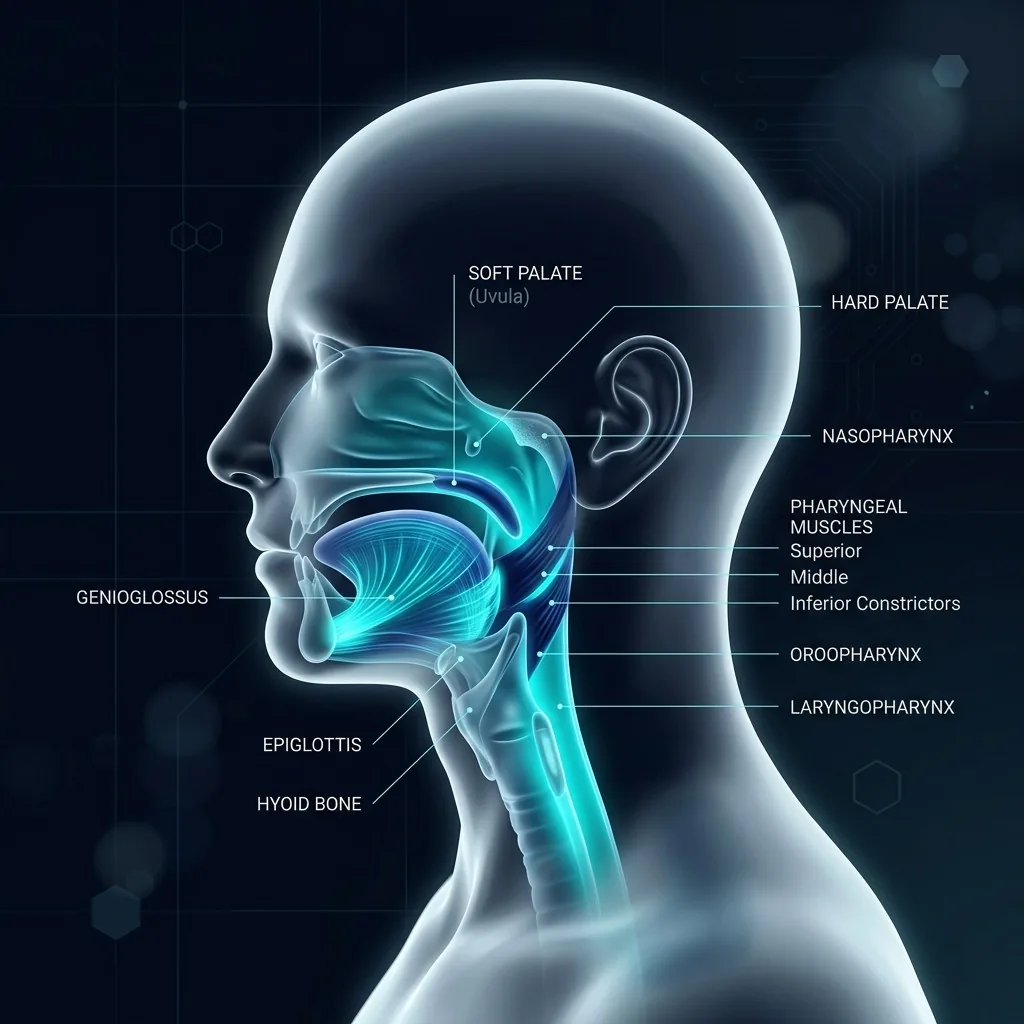
Obstructive sleep apnea is repeated upper-airway narrowing or collapse during sleep. Extra soft tissue is one of the most common amplifiers: fat pads at the tongue base and soft palate shrink the lumen, and central body mass can change chest mechanics. Sleep clinicians have long said that losing about 10-20% of body weight can meaningfully improve AHI for many people with obesity-linked OSA - and that sticking the landing with diet alone is hard.
That is why incretin medicines entered the OSA conversation. Tirzepatide pairs GIP and GLP-1 activity as a weekly injection. Orforglipron is a daily oral GLP-1 receptor agonist. Retatrutide is a separate investigational triple agonist. In OSA trials, the clinical bet is mostly mechanical and metabolic: less tissue bulk and lower weight should reduce collapse frequency, with possible secondary gains in symptoms and cardiometabolic markers. These are not hypoglossal nerve stimulators and not CPAP masks.
Fat pads shrink the airway
Weight can crowd the throatExtra soft tissue around the tongue base, soft palate, and pharyngeal sidewalls narrows the path air must travel. Sleep and obesity clinicians describe this as one of the most common reversible amplifiers of snoring and OSA when BMI is high.
Chest and belly load the airway
Body mass changes breathing mechanicsCentral adiposity can reduce how easily the chest expands and how the diaphragm moves. That raises the work of breathing and can worsen collapse even when the nose is clear. Weight loss can improve mechanics without fixing every anatomic bottleneck.
Oral orforglipron is a daily GLP-1 pill
Same weight lane, different deliveryFoundayo (orforglipron) is a small-molecule, non-peptide oral GLP-1 receptor agonist taken once daily. ATTAIN-OSA tested it for 52 weeks in moderate-to-severe OSA with overweight or obesity. Benefits track with substantial average weight loss and related cardiometabolic shifts. It is not a tongue-protrusion implant, not CPAP, and not the same mechanism as neuromuscular oral candidates such as AD109.
Tone and anatomy still matter
Weight loss is not a universal snore curePeople with normal BMI still snore and develop OSA when jaws, tonsils, nasal blockage, or floppy palate tissue dominate. Residual vibration after weight change is common. Airway muscle training targets that residual mechanical load.
What the 2026 ATTAIN-OSA trials showed
On November 9, 2026, JAMA published ATTAIN-OSA alongside presentation at the American Heart Association Scientific Sessions. Adults with moderate-to-severe OSA and BMI of at least 27 were randomized 1:1 to once-daily oral orforglipron or placebo for 52 weeks. Orforglipron started at 0.8 mg and titrated toward a maximum tolerated dose of 9, 14.5, or 17.2 mg. Trial 1 enrolled people not receiving PAP (n=363 analyzed pathway). Trial 2 enrolled people already on PAP for at least 3 months (n=349). Primary end point: change in AHI.
| Cohort (JAMA treatment-regimen) | Orforglipron | Placebo | Difference |
|---|---|---|---|
| Trial 1 (no PAP) mean AHI change, events/h | -17.8 | -4.5 | -13.2 |
| Trial 2 (on PAP) mean AHI change, events/h | -17.3 | -5.3 | -12.0 |
Values are mean AHI changes in events per hour at 52 weeks using the treatment-regimen estimand reported in the JAMA research summary (doi 10.1001/jama.2026.24226; full investigation doi 10.1001/jama.2026.24080). Confidence intervals and other estimands are in the full paper. This table is educational paraphrase, not a substitute for the primary publication.
Company and specialty coverage of the same package also highlighted secondary framing: non-PAP relative AHI reduction about 43.8% from a ~50.7 baseline, with about 47% reaching at least a 50% AHI drop and about 31.5% reaching mild disease or remission categories; PAP relative reduction about 27.5%; hypoxic-burden cuts near 56% and 46%; average weight loss near 28 lb (~11%); hsCRP down roughly 39-49%; systolic blood pressure down about 7-9 mmHg. GI events were the main tolerability signal (roughly two-thirds of active-drug participants in JAMA summary rates), and discontinuations were higher on orforglipron than placebo.
Context from the prior standard: our 2026 treatment landscape page covers tirzepatide/Zepbound after SURMOUNT-OSA and the December 2024 FDA OSA approval, plus AD109 oral neuromuscular candidates. Our retatrutide insight covers the separate triple-agonist injection lane. Foundayo is the daily-pill weight-path newsjack inside that same incretin family, not a replacement for CPAP counseling or for non-weight OSA phenotypes.
Who these results apply to
Who ATTAIN-OSA enrolled
- Adults with moderate-to-severe OSA and BMI at least 27
- One trial without PAP use; one trial with stable PAP for at least 3 months
- Lifestyle counseling in both active and placebo arms for 52 weeks
- Most participants had severe disease at baseline in press summaries of the program
Who is less likely to see a "cure" from a weight-loss pill alone
- Primary snoring or OSA driven mainly by jaw structure, large tonsils, or fixed nasal blockage
- Normal-weight snorers without a fat-pad phenotype
- Anyone expecting a weekend fix without clinician follow-up or a sleep diagnosis
- People who need immediate airway support for severe oxygen desaturations while waiting months for weight change
See a clinician first if...
- Gasping, choking, witnessed pauses, or severe daytime sleepiness
- You are already on CPAP, an oral appliance, or oxygen and want to change therapy
- History of pancreatitis, medullary thyroid cancer risk factors, or other GLP-1 class cautions your clinician tracks
- Unintentional weight loss, chest pain, or other red-flag symptoms unrelated to elective weight therapy
Practical next steps
Get a real OSA diagnosis before chasing a drug headline
Trial enrollment required documented moderate-to-severe OSA. A partner video of snoring is not a sleep study. Use screening tools as a conversation starter, then pursue home or lab testing when indicated.
Separate three different "oral OSA" stories
Foundayo/orforglipron is an oral GLP-1 weight-path drug with phase 3 OSA data and a planned FDA OSA filing. Zepbound (tirzepatide) is already labeled for OSA with obesity as a weekly injection. AD109 is a non-GLP neuromuscular nightly pill with its own phase 3 package and a separate PDUFA clock. Do not treat them as interchangeable.
Plan for months, not nights
ATTAIN-OSA ran 52 weeks. SURMOUNT-OSA ran 52 weeks. Expect gradual AHI and weight change under medical supervision, with GI side effects as the most common trade-off in published orforglipron and tirzepatide programs.
Keep a residual-snoring plan
Even when AHI improves, soft-palate vibration, nasal blockage, alcohol timing, back sleep, and weak airway tone can keep nights loud. Positional habits, nasal care, prescribed PAP/oral appliances when indicated, and oropharyngeal training cover different residual pieces.
This page is educational, not prescribing advice. Weight-loss medicines require a licensed clinician, ongoing monitoring, and a plan for what happens to CPAP or oral appliances as AHI changes. Do not stop prescribed therapy because a trial abstract looks encouraging.
Expert videos on oral GLP-1s, weight, and OSA
Clinician framing and demonstration context only. Clinical claims on this page are grounded in the Sources list, not in video captions. Foundayo-specific ATTAIN-OSA clips are still sparse right after the JAMA drop, so we pair oral-pill explainers with sleep-physician GLP-1 context and a labeled tirzepatide clinician guide.
Sleep Takeout (Dr Michelle Zeuthen, pulmonary/sleep + Dr Daniel Barone) - oral orforglipron accessibility vs injectables, why Zepbound still owned the OSA label at recording, insurance vs FDA framing, and why weight loss is not a universal CPAP replacement.
MedHeads - plain walkthrough of why oral OSA candidates matter for people who cannot live with CPAP, and how headline percent drops need placebo context (useful framing even when the clip centers a different oral pathway).
WXYZ-TV Detroit - hospital health-desk explanation of why a simple nightly pill is newsworthy next to CPAP, oral appliances, implants, and labeled weight-path drugs.
Sleep is My Waking Passion ft. Dr Alison Kole - sleep-physician view of obesity-linked OSA, GLP-1s as one tool, and why nutrition and movement still determine long-term results.
IntraBalance / Dr Audrey Wells - clinician guide to the already-labeled tirzepatide OSA pathway: phenotype, expectations, and residual disease after weight change (sibling context for Foundayo readers).
When airway exercises still help
Weight-path drugs shrink bulk. They do not automatically stiffen a floppy soft palate or teach a low tongue posture. If partners still hear vibration after meaningful weight loss - or if you are in the long titration window before AHI is restudied - oropharyngeal training is a low-tech adjunct with randomized support.
Ieto 2015 reduced snoring frequency and power with oropharyngeal exercises. Guimaraes 2009 improved OSA severity versus sham. Camacho 2015 pooled myofunctional therapy trials and found meaningful average AHI and snoring gains in selected groups. None of that replaces diagnosis, PAP when indicated, or clinician-managed medication.
Practical next reads on this site: soft-palate drills, tongue exercises, and the clinical-studies roundup. Guided daily routines live in the Airway Trainer app.
When to see a doctor
Obstructive sleep apnea is a medical diagnosis. Loud snoring plus gasping, witnessed pauses, resistant high blood pressure, atrial fibrillation, or crushing daytime sleepiness deserves a sleep evaluation - not a self-start peptide stack or a social-media dosing chart.
GLP-1 class medicines have real contraindications, GI adverse events, and monitoring needs. If you already use CPAP or an oral appliance, do not abandon it because a phase 3 press release looks strong. Ask your clinician how weight-path drugs, neuromuscular oral candidates, implants, and behavioral levers fit your phenotype. Screening tools such as our STOP-BANG calculator are conversation starters, not prescriptions.
Sources
- 1.Malhotra A, Gottlieb DJ, Woehrle H, et al; ATTAIN-OSA Investigators. Orforglipron for obstructive sleep apnea: results from 2 randomized clinical trials (ATTAIN-OSA). JAMA. Published online November 9, 2026. doi: 10.1001/jama.2026.24080. ClinicalTrials.gov NCT06649045.
Two phase 3, multicenter, double-blind, placebo-controlled trials (712 randomized adults with moderate-to-severe OSA and BMI at least 27). Trial 1 (n=363) enrolled people not on PAP; trial 2 (n=349) enrolled people on PAP for at least 3 months. Once-daily oral orforglipron was titrated from 0.8 mg toward maximum tolerated 9, 14.5, or 17.2 mg versus placebo for 52 weeks, with lifestyle counseling in both arms. Primary end point: change in apnea-hypopnea index (AHI). Treatment-regimen estimand at week 52: trial 1 mean AHI change -17.8 vs -4.5 events/h on placebo (difference -13.2); trial 2 -17.3 vs -5.3 (difference -12.0). Gastrointestinal adverse events were more common on active drug. Sponsored by Eli Lilly. Educational paraphrase only; read the full paper for estimands, intervals, and safety.
- 2.Orforglipron for Obstructive Sleep Apnea: Research Summary. JAMA. Published online November 9, 2026. doi: 10.1001/jama.2026.24226.
JAMA research summary of the ATTAIN-OSA pair: participant profile, titration scheme, primary AHI contrasts, GI adverse-event rates, and limits (52-week duration, mostly severe OSA, limited diversity, diabetes and mild OSA excluded).
- 3.Eli Lilly / company and trade coverage of ATTAIN-OSA at AHA Scientific Sessions 2026 (Nov 9, 2026): Foundayo (orforglipron) OSA secondary outcomes and planned FDA submission timing.
Press and specialty coverage of secondary outcomes presented with the JAMA package: non-PAP cohort relative AHI reduction up to about 44% from baseline with roughly half achieving at least 50% AHI drop and about 31.5% reaching remission or mild disease in company-reported framing; PAP cohort relative reduction about 27.5%; sleep apnea-specific hypoxic burden reductions about 56% (non-PAP) and 46% (PAP); mean weight loss about 28 lb (~11%); hsCRP and systolic blood pressure improvements; GI-dominant safety consistent with prior orforglipron programs; planned U.S. OSA submission by end of 2026. Secondary press numbers can use different estimands than the JAMA primary LS means; prefer the paper for decision-grade reading.
- 4.Malhotra A, et al. N Engl J Med. 2024;391:1193-1205. Tirzepatide for the treatment of obstructive sleep apnea and obesity. doi: 10.1056/NEJMoa2404881. PMID: 38912654.
SURMOUNT-OSA phase 3 program: once-weekly tirzepatide vs placebo in adults with moderate-to-severe OSA and obesity. Established the first large incretin OSA evidence base that oral orforglipron ATTAIN-OSA builds on in a pill format.
- 5.U.S. Food and Drug Administration / Eli Lilly. FDA approves Zepbound (tirzepatide) for moderate-to-severe obstructive sleep apnea in adults with obesity. December 2024.
Regulatory milestone: tirzepatide (Zepbound) became the first prescription medicine FDA-approved specifically for moderate-to-severe OSA in adults with obesity, used with a reduced-calorie diet and increased physical activity. Separate product and label from oral Foundayo/orforglipron and from investigational retatrutide.
- 6.Mayo Clinic. Obstructive sleep apnea: Diagnosis and treatment.
Patient-facing overview of OSA evaluation and treatment options (CPAP, oral appliances, lifestyle, surgery) and why weight is a major but not universal driver of airway collapse.
- 7.Mayo Clinic. Snoring: Diagnosis and treatment.
Clinical snoring overview: lifestyle factors, when snoring warrants apnea evaluation, and that anatomy and muscle tone still matter after weight change.
- 8.Ieto V, et al. Chest. 2015 Sep;148(3):683-691. PMID: 25950418.
Randomized trial: oropharyngeal (airway) exercises reduced snoring frequency and snoring power in habitual snorers - a non-drug path to lower vibration load when tone is part of the problem.
- 9.Guimaraes KC, et al. Am J Respir Crit Care Med. 2009 May 15;179(10):962-968. PMID: 19234106.
Randomized trial: daily upper-airway exercises improved obstructive sleep apnea severity and snoring versus sham control.
- 10.Camacho M, et al. Sleep. 2015 May 1;38(5):669-675. PMID: 25348130.
Meta-analysis of myofunctional therapy for OSA: pooled trials show meaningful reductions in snoring and apnea-hypopnea index in selected populations.
FAQ
What is Foundayo (orforglipron) and how is it different from Zepbound?+
Foundayo is the brand name for orforglipron, a once-daily oral small-molecule GLP-1 receptor agonist. Zepbound is tirzepatide, a once-weekly dual GIP/GLP-1 injection that already has FDA approval for obesity and, separately, for moderate-to-severe OSA in adults with obesity. Foundayo is already on a weight-management path in the U.S. market story, but an OSA-specific label still depends on regulatory review of ATTAIN-OSA. The two drugs are not interchangeable doses or delivery forms.
Does Foundayo cure sleep apnea?+
No medication in these programs is framed as a universal cure. In ATTAIN-OSA, oral orforglipron lowered average AHI more than placebo over 52 weeks in both PAP and non-PAP cohorts, with additional improvements in hypoxic burden, weight, blood pressure, and inflammation markers in company-reported secondary outcomes. Individual response still varies, GI adverse events are common, and anatomy-driven OSA can remain after weight loss.
How much did AHI fall in ATTAIN-OSA?+
Using the JAMA treatment-regimen estimand at week 52: without PAP, mean AHI change was -17.8 events/hour on orforglipron versus -4.5 on placebo (difference -13.2). With PAP, changes were -17.3 versus -5.3 (difference -12.0). Company presentations also highlighted relative reductions from baseline of about 44% (non-PAP) and 27.5% (PAP), plus rates of at least 50% AHI improvement and mild/remission categories. Always read the full JAMA paper for estimands, intervals, and safety.
Is Foundayo already FDA approved for sleep apnea?+
As of the November 9, 2026 JAMA/AHA package, ATTAIN-OSA is phase 3 evidence plus a stated plan for Lilly to submit an OSA indication by the end of 2026. That is not the same as an approved OSA label on the pharmacy shelf. Tirzepatide/Zepbound remains the labeled incretin option for moderate-to-severe OSA with obesity in the United States. Confirm current labeling with FDA materials and your clinician; this page is educational.
How is Foundayo different from AD109?+
Foundayo/orforglipron is a GLP-1 weight-loss medicine studied for OSA in people with overweight or obesity. AD109 is a different oral candidate that combines atomoxetine and aroxybutynin to target upper-airway muscle control during sleep, without relying on the same weight-first pathway. AD109 has its own phase 3 story and a separate FDA review timeline discussed on our 2026 treatments landscape page. Mechanism, side-effect profile, and ideal phenotype are not the same.
Do I still need CPAP if I start an oral GLP-1?+
Many people should keep prescribed airway therapy until a clinician restudies breathing after meaningful weight change. CPAP remains first-line for many moderate-to-severe OSA phenotypes. ATTAIN-OSA carefully defined PAP and non-PAP cohorts; real-world decisions belong with your sleep clinician, not a blog post.
Can airway exercises help while weight is changing?+
Yes as an adjunct for the muscle-tone half of snoring. Randomized oropharyngeal programs (Ieto 2015, Guimaraes 2009) and a myofunctional therapy meta-analysis (Camacho 2015) support lower snoring load and, in selected groups, better AHI. Exercises do not replace OSA diagnosis, PAP when indicated, or clinician-managed weight therapy.
Train the residual airway while weight therapy does its job
Airway Trainer guides short daily oropharyngeal drills so soft-palate and tongue tone stay on the plan - alongside, not instead of, clinician-managed OSA care.