Is mouth taping safe?
Short version: only in a narrow, clear-nose niche - and never as a DIY apnea fix. Viral clips make overnight lip seals look harmless. Clinicians and a 2025 evidence review disagree when the nose is blocked or sleep apnea is in play. This page is the safety companion to our efficacy guide: risks, hard stops, temporary habit rules, and what to try instead.


Quick answer
Mouth taping is not automatically safe just because it is popular. For a healthy adult with a genuinely clear nose, no apnea warning signs, and a plan to stop at the first panic or breathing struggle, overnight lip sealing is usually low risk as a short experiment. That is a narrow group.
For everyone else the risk profile changes fast. A 2025 systematic review of 10 studies (213 patients) judged benefits marginal and limited to mild cases, said mouth taping is not recommended in moderate-to-severe OSA, and warned of asphyxiation when nasal airflow is blocked. Cleveland Clinic patient education adds skin irritation, anxiety, and breathing difficulty, and tells people who snore or may have apnea to talk to a clinician first.
Efficacy is a separate question - and thin. See does mouth taping work for snoring for the snoring evidence. This page stays on safety: when tape is a hard no, when it is a temporary habit tool, and what treats throat-level snoring without sealing your backup airway.
Why safety depends on the nose, not the TikTok clip
Mouth tape has one job: keep the lips together so air prefers the nose. Nose breathing can filter, warm, and humidify air. That physiology is real. The safety failure mode is also simple: if the nose cannot carry enough flow, the mouth is the emergency exit. Tape closes the exit.
ENT educators who review viral tape often split two use cases. The first is wellness-trend taping in people who may already have congestion or undiagnosed apnea - high caution. The second is temporary mouth-closure training after the nose has been medically opened (spray response, allergy control, septoplasty, polyp care) but the sleeper still mouth-breathes by habit. That second case is still not risk-free, but it is the only setting where many sleep surgeons describe a time-limited role.
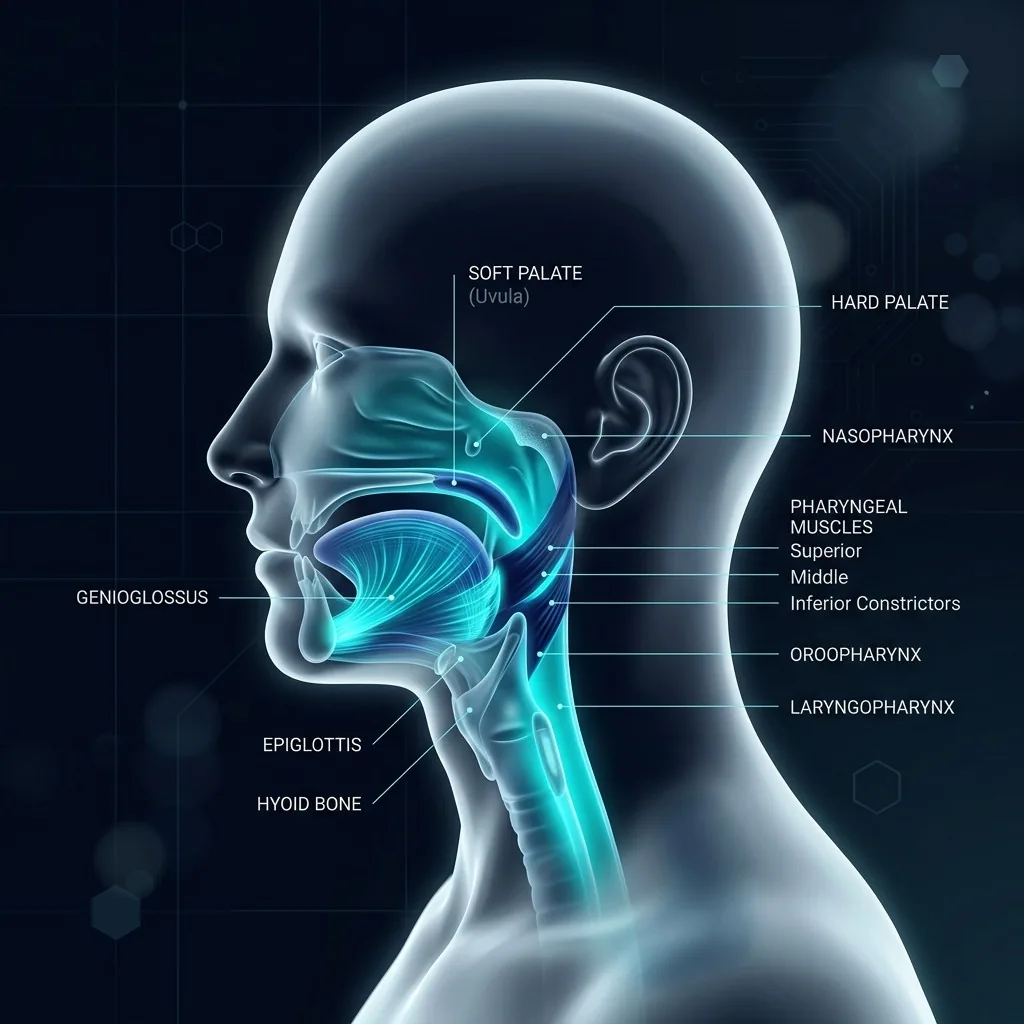
Tape never strengthens the soft palate or tongue base. It never stents a collapsible pharynx. If your snore is throat vibration, sealing the lips can quiet the bedroom while the airway problem continues - or while oxygen still dips. Quieter is not the same as safer.
The main mouth-taping risks
Do not tape
Blocked or partly blocked nose
Congestion, colds, allergies, polyps, or a fixed septal curve can make the mouth your backup airway. Sealing the lips removes that backup. The 2025 systematic review flags asphyxiation risk in this exact scenario, and hospital/news clinician segments echo the same hard stop.
Medical evaluation first
Suspected or known sleep apnea
Rhee and colleagues state mouth taping is not recommended in moderate-to-severe OSA. Quieter nights can hide pauses, oxygen dips, and daytime sleepiness that need diagnosis and real treatment (CPAP, oral appliance, positional care, or other clinician-directed options).
Common and under-discussed
Skin, anxiety, and comfort side effects
Cleveland Clinic lists skin irritation, anxiety, and difficulty breathing as reasons people stop. Panic or claustrophobia can hit even healthy nose breathers. Daytime nose-only practice is a safer test than jumping straight to overnight tape.
Lower risk niche
Clear nose, no apnea red flags, temporary habit work
After nasal surgery or successful nasal treatment, some people still mouth-breathe by habit. ENT educators sometimes use temporary mouth closure (tape or chin strap) for weeks to retrain nose breathing - not as a forever snoring cure, and only when the nose is genuinely open.
Who should skip tape vs who might try
Hard skip list
- Nasal congestion, colds, allergies, polyps, or untreated septal blockage
- Gasping, choking, witnessed pauses, or a high STOP-BANG score
- Known moderate-to-severe OSA without clinician sign-off
- Pregnancy, heavy alcohol or sedative nights, or inability to remove tape alone
- Active skin disease around the lips, recent facial surgery, or severe claustrophobia
Possible short trial only if...
- Documented clear nasal airflow after ENT or allergy care
- Habitual mouth breathing that persists after the nose is fixed
- Mild primary snoring without apnea red flags, used as a short experiment
- Willingness to stop immediately if sleep worsens or anxiety spikes
A partner saying "you snore less" is not a clearance. Multi-night oxygen dips, morning headaches, and STOP-BANG risk still need a clinical conversation. Use our free STOP-BANG calculator as a screen, not a diagnosis.
Safer rules if you still choose a short trial
1. Prove you can nose-breathe while awake
Sit quietly with lips closed for 10-20 minutes. If you feel air hunger, panic, or constant need to open the mouth, fix the nose first. Do not graduate to overnight tape until daytime nose breathing is easy.
2. Use gentle, purpose-built tape only
Researchers and clinicians talk about hypoallergenic paper or silicone medical tapes, not duct tape or random packaging tape. Commercial mouth tapes exist; none are a substitute for a diagnosis. Stop at first skin breakdown or rash.
3. Keep an exit plan
Leave a pull-tab so you can remove tape quickly half-asleep. If you wake gasping, remove it and treat that night as a fail, not a toughness test. Never tape a child, a heavily sedated person, or anyone who cannot remove tape themselves.
4. Treat tape as temporary training, not a lifestyle identity
Habit-retraining use cases last weeks, not years. If you need tape every night forever to feel safe, something else (nose, jaw, tongue base, or apnea) is still unresolved.
These rules reduce avoidable harm. They do not make tape a medical treatment, and they do not override a clinician who told you not to seal your mouth overnight.
Expert videos on mouth tape risks and caveats
Clinician and science framing only. Clinical claims on this page cite the Sources list, not video captions.
Vik Veer, NHS ENT / sleep surgeon - why he is cautious about trend taping, when temporary mouth closure might help after the nose is fixed, and why sealing lips is dangerous with polyps, blockage, or untreated apnea.
Vik Veer device review - chin strap vs tape as short-term nose-breathing habit tools, not throat-snoring cures, plus the explicit do-not-use warning when apnea oxygen drops are present.
Dr. Steven Park, ENT and sleep medicine - personal experiment with tape placement, daytime nose-breathing test first, and how an open jaw drops the tongue base on sleep endoscopy.
SciShow - peer-reviewed framing, gentle tape types used in research, mouth-puffing observations, and why cure-all social claims overshoot the data.
TODAY medical segment - Cleveland Clinic style caution that more studies are needed, the trend is not recommended as blanket advice, and sealed lips plus a blocked nose is a serious risk combination.
Safer paths when the goal is less snoring
If the nose is the bottleneck, treat the nose: allergy control, saline, clinician-guided sprays, dilators as a temporary valve test, or ENT review for structural blockage. Forcing a closed mouth on a blocked nose is the opposite of a fix. See nasal dilators and deviated septum and snoring.
If the snore is soft-palate or tongue-base vibration, training beats taping. Randomized trials of oropharyngeal exercises (Ieto 2015; Guimaraes 2009) and Camacho's myofunctional therapy meta-analysis support reductions in snoring and, in selected groups, apnea-hypopnea index - by changing muscle tone where collapse happens, not by sealing the lips.
That is the Airway Trainer path: short daily tongue, palate, and throat work so the airway holds itself open more of the night. It is not a substitute for CPAP when you need pressure therapy, and it is not a reason to ignore apnea red flags.
Keep reading in the device and exercise cluster:
When to see a doctor before any tape
Get evaluated - and do not overnight-tape - if any of these are true:
- Gasping, choking, or witnessed pauses in breathing
- Loud snoring most nights plus daytime sleepiness
- Chronic nasal blockage, recurrent sinus disease, or prior failed nasal surgery
- Heart disease, uncontrolled blood pressure, or morning headaches
- You wake with the tape half-torn and feel air-hungry
- A partner says you stop breathing even when the room is quieter
Airway Trainer is a wellness exercise tool. It does not diagnose sleep apnea, clear a blocked nose, or make overnight mouth sealing safe. Exercises and consumer devices support care; they do not replace it.
Sources
- Rhee J, et al. PLOS One. 2025;20(5):e0323643 (systematic review).
Review of 10 studies (213 patients): benefits of mouth taping were marginal and limited to mild cases; not recommended in moderate-to-severe OSA; serious asphyxiation risk when the nose is obstructed. - Cleveland Clinic. "Mouth Taping: Is It Safe To Use?" (health library).
Clinician guidance: mouth taping can cause skin irritation, anxiety, and difficulty breathing; do not use if you snore, have sleep apnea, nasal obstruction, congestion, allergies, sinus infection, enlarged tonsils, deviated septum, or heart issues without medical advice. - Houston Methodist. Can Mouth Tape During Sleep Be Dangerous? (Zahiruddin, sleep medicine).
Hospital sleep-medicine explainer: low-quality research base; asphyxiation risk with nasal obstruction, sleep apnea, regurgitation/GERD; not recommended with chronic congestion, heart/lung disease, or asthma; if trialed, prefer small strip of hypoallergenic micropore tape. - Lee YC, Lu CT, Cheng WN, Li HY. Healthcare (Basel). 2022 Sep 13;10(9):1755. PMID: 36141367.
Preliminary study of 20 mouth-breathers with mild OSA: 65% had at least a 50% drop in snoring index; median snoring index and AHI each fell about 47% in a carefully screened clear-nose group. - Ieto V, et al. Chest. 2015 Sep;148(3):683-691. PMID: 25950418.
Randomized trial: oropharyngeal (airway) exercises reduced snoring frequency and snoring power in habitual snorers - a non-tape path when the problem is throat tone. - Guimaraes KC, et al. Am J Respir Crit Care Med. 2009 May 15;179(10):962-968. PMID: 19234106.
Randomized trial: daily upper-airway exercises improved obstructive sleep apnea severity and snoring versus sham control. - Camacho M, et al. Sleep. 2015 May 1;38(5):669-675. PMID: 25348130.
Meta-analysis of myofunctional therapy for OSA: pooled trials show reductions in snoring and apnea-hypopnea index in selected populations.
Mouth taping safety FAQs
Is mouth taping safe?
It can be low risk for a carefully selected adult with a genuinely clear nose and no sleep-apnea red flags, but it is not universally safe. Cleveland Clinic warns about skin irritation, anxiety, and breathing difficulty, and advises against unsupervised use if you snore or may have apnea. A 2025 systematic review (Rhee et al., PLOS One) flags serious asphyxiation risk when the nose is obstructed and says mouth taping is not recommended in moderate-to-severe OSA. Safety hinges on nasal patency and screening, not on how viral the trend is.
Who should never mouth tape?
Skip overnight tape if your nose is blocked (cold, allergies, polyps, untreated deviation), if you gasp or have witnessed breathing pauses, if you already have moderate-to-severe sleep apnea without clinician guidance, if you are heavily sedated or intoxicated, if you cannot remove the tape yourself, or if you are taping a child. Those are hard stops, not personal preferences.
Can mouth taping cause sleep apnea or make it worse?
Tape does not create OSA from nothing, but it can worsen breathing stress when nasal airflow is limited and it can mask snoring that was a useful warning sign. Reviewers warn that sealing the mouth when the nose cannot carry the load is the dangerous combination. If apnea is already present, quieter noise is not the same as safer breathing.
Is there FDA-approved mouth tape for snoring?
Patient-facing clinician segments (including local news interviews with physicians) note there is no FDA-approved mouth tape product category that proves sleep-quality or snoring cures. Commercial tapes are consumer products. Lack of FDA approval for a wellness claim is not the same as an automatic ban, but it does mean marketing claims outrun regulated evidence.
What side effects should I expect?
Common issues include lip and skin irritation, adhesive residue, anxiety or panic when the mouth feels sealed, dry or dry-feeling nasal passages if you force nose breathing through a tight nose, and disrupted sleep from constantly checking the tape. SciShow-style explainers also cover mouth puffing (air still circulating in the oral cavity behind a sealed lip line) in research settings - another reminder that tape is not a perfect seal of the whole airway problem.
Is a chin strap safer than mouth tape?
Both keep the mouth closed. Neither opens a collapsed throat. A chin strap can be easier to remove half-asleep and is sometimes preferred by ENTs for short-term nose-breathing habit training after the nose is cleared. Straps can still push the jaw awkwardly, irritate the skin, or feel ridiculous. Safety still depends on clear nasal airflow and ruling out significant apnea - not on which gadget you pick.
What should I try instead of mouth tape for snoring?
Match the fix to the cause. Treat nasal blockage first when congestion is the driver. For throat- and palate-based snoring, randomized trials of oropharyngeal exercises (Ieto 2015, Guimaraes 2009) and a myofunctional therapy meta-analysis (Camacho 2015) support reducing snoring and, in selected groups, apnea-hypopnea index. Position change, oral appliances, and medical OSA care cover other phenotypes. See our companion efficacy page for how thin the snoring evidence for tape itself is.
Train the airway you cannot tape
Airway Trainer is a 5-minute daily routine for tongue, palate, and throat tone - the tissues a lip seal never reaches. Use it after you have screened for apnea and cleared nasal blockers, not as a reason to ignore them.
Related: Does mouth taping work? · Chin straps · Device guide